India’s tribunal reform discourse often treats digitisation as a question of introducing e-filing, virtual hearings, and online access to basic case information.




Anshuman Sahoo



India's regulatory appellate architecture rests on a foundational but underarticulated premise that appellate review of expert regulatory decisions should be corrective rather than substitutive.

Legal disputes characteristically arise not at the settled core of doctrine but at its penumbra, where evolving economic and social realities strain inherited conceptual categories.
Digital platform markets challenge conventional modes of competition enforcement by amplifying feedback effects, cumulative advantage, and temporal irreversibility.
The real world is complex, and mostly beyond human comprehension. Even the simplest phenomena like birds flying in geometrically-shaped flocks, or termites coordinating to build castles matching the best of human architecture perplexes us, exposing the limitations of our cognition.

This blog examines the role of Information Utilities (IUs) in India’s Insolvency and Bankruptcy Code and argues that their current design and functioning exhibit instances of epistemic fragmentation.

Khushbu Shah
The Commercial Courts Act, 2015 was amended in 2018 to introduce, among other things, the Pre-Institution Mediation and Settlement (PIMS) mechanism under Section 12A.
In Catalyst Trusteeship Ltd. v. Ecstasy Realty Pvt. Ltd., the Supreme Court of India revisited a fundamental question under the Insolvency and Bankruptcy Code, 2016
The Debts Recovery Tribunal Regulations, 2024 that were introduced on 21st September, 2024 (Regulations) lay down detailed procedural rules governing Debt Recovery Tribunals (DRTs)
The Bruhat Bengaluru Mahanagara Palike (BBMP), the municipal corporation of Bengaluru city, till recently, managed core urban municipal functions in Bengaluru, including property tax administration, building regulations, and licensing.
High-value debt recovery cases play a disproportionately important role in India’s financial system. While such cases reportedly constitute a very small fraction of the total caseload before Debt Recovery Tribunals (DRTs), they account for a dominant share of the total value of claims, prompting policy measures such as the creation of special DRT benches for cases above specified monetary thresholds.

When two statutes with strong and overlapping powers apply to the same situation, a conflict of authority is inevitable.

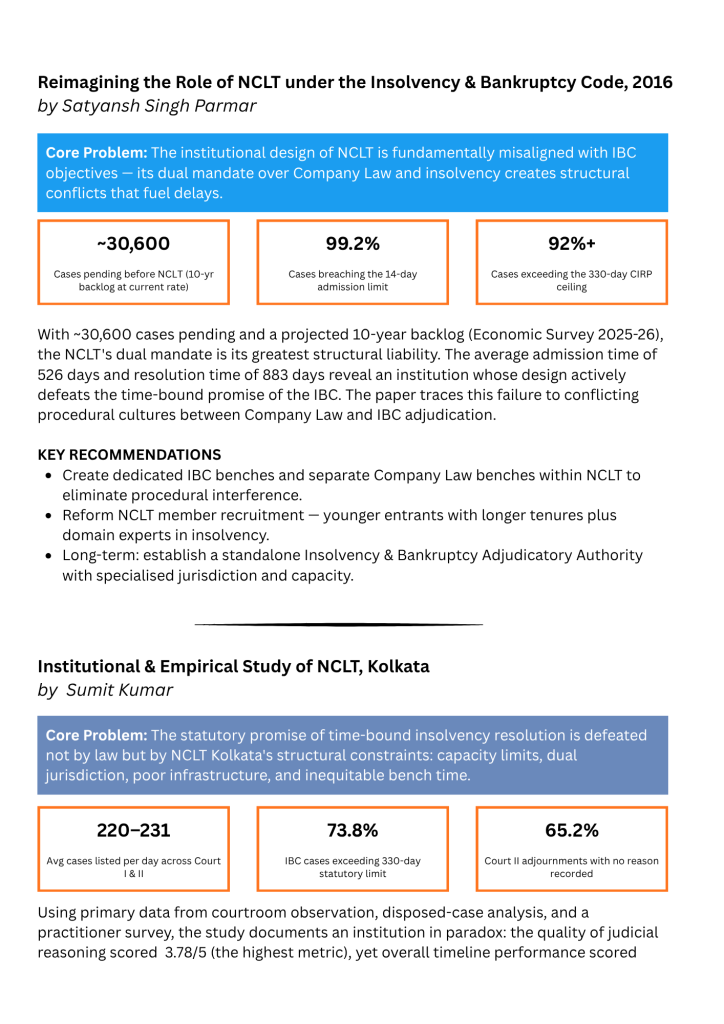
Satyansh Singh Parmar
The Insolvency and Bankruptcy Code (IBC) was built upon the recommendations of the BLRC committee led by TK Vishwanathan.
For almost a decade, the 14 day timeline under Section 7(4)1 of the Insolvency and Bankruptcy Code, 2016 (IBC) was treated by the Adjudicating Authority(AA) as directive rather than mandate.
The proposal for a National Tribunal Commission (NTC) in India addresses a long standing structural issue that currently ties tribunals to their parent ministries.
India in the past few years has spent thousands of crores on digitalisation of courts through e-filling, virtual hearings or case management systems in District Courts, High Courts and the Supreme Court through the e-Courts mission mode project1.
The National Company Law Tribunal has recently conducted a recruitment process for their Law Research Associates (LRA) through a multi-tiered selection process notified in late 2025 for all benches throughout India.

The blog post attempts to examine the extent and nature of delays, highlighting that as of 2025, over 1,500 matters still remain pending before APTEL, some dating back more than a decade.

Sumit Kumar
The National Company Law Tribunal (NCLT) was created by Parliament as the adjudicating authority (AA) for India's corporate insolvency framework.
The Insolvency and Bankruptcy Code (Amendment) Bill, 2025 is one of the biggest legislative interventions in India's insolvency framework since 2016.
The Insolvency and Bankruptcy Code of 2016 drew a 330 day outer ceiling for corporate insolvency resolution.
Discussions on technology in the judiciary today often centre around ambitious ideas. Artificial Intelligence (hereinafter AI), blockchain, Internet of Things (hereinafter IoT) and automated case management systems are regularly projected as the future of courts.
When people talk about India’s telecom story, the spotlight falls on 5G auctions, startups and big telecom companies. Fewer notice the small, specialised tribunal that regularly decides the rules those markets live by, the Telecom Disputes Settlement and Appellate Tribunal (TDSAT).
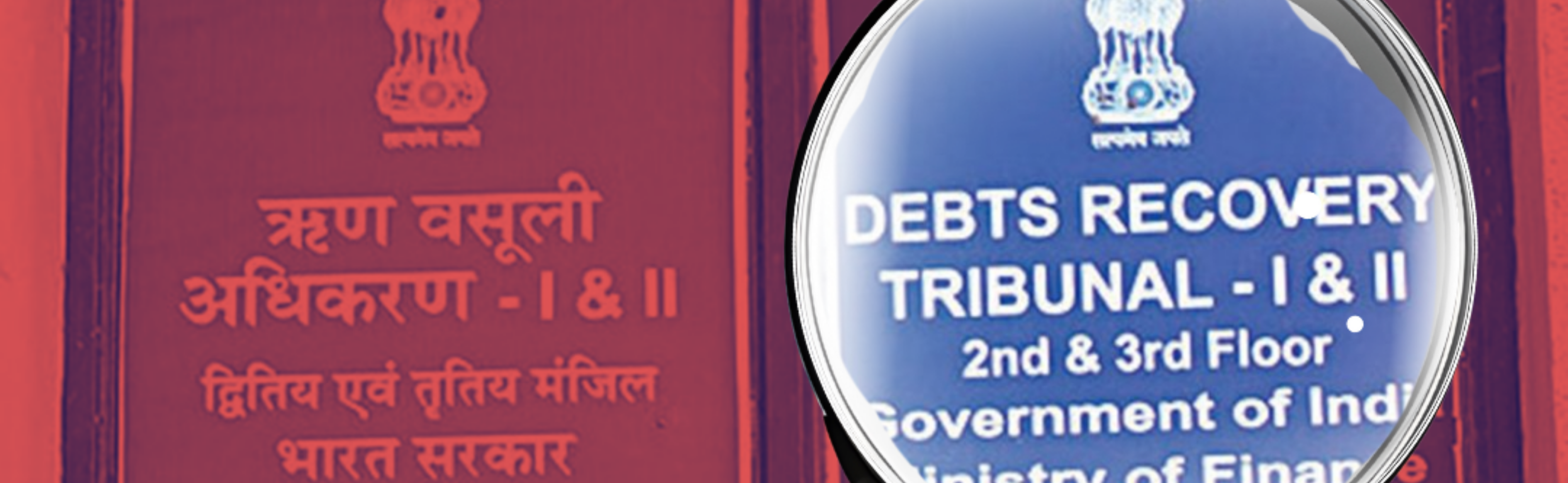
The Debt Recovery Tribunal (DRT) system, introduced under the Recovery of Debts Due to Banks and Financial Institutions Act, 1993 (RDDBFI Act), was seen as India’s institutional answer to the inefficiency of the civil courts in handling financial disputes.

Sundaramurti Ramesh
When Parliament enacted the Insolvency and Bankruptcy Code, 2016 (IBC), it did so with utmost urgency.
India’s insolvency infrastructure generates a huge amount of information, but most of it sits scattered across government websites in formats that are difficult to analyse.
Anyone who has tried to study how well India’s insolvency tribunals actually perform quickly encounters a frustrating paradox: the questions that matter most to policymakers are precisely the ones the available data makes hardest to answer.
Tribunals occupy a central position in India’s justice framework. Conceived as specialised adjudicatory bodies operating outside the traditional judiciary, they aim to deliver faster dispute resolution while incorporating subject-matter expertise.
The integration of artificial intelligence into legal decision-making is no longer speculative. Large language models (LLMs), trained on massive corpora of text and capable of sophisticated pattern recognition, now demonstrate unprecedented competence in core legal tasks such as extracting issues from pleadings, mapping statutory

India’s judiciary, a constitutionally mandated pillar of democracy, exemplifies a pure public good characterised by non-excludability and non-rivalry. This study examines judicial efficiency as public good provision, analysing empirical data from 2018 and 2024 to document a deepening crisis in access to justice.

Swikruti Mohanty
The digitisation of courts is often associated with increased procedural transparency and improved access to information.
The National Financial Reporting Authority was established in 2018 as a direct response to the Punjab National Bank Scam, to strengthen audit accountability and enhance investor confidence.
The National Financial Reporting Authority (NFRA) has recently decided to voluntarily pause its disciplinary proceedings while awaiting the Supreme Court’s verdict on the enforceability of its orders.
The Supreme Court of India issued a mandate in October 2023 directing all High Courts and Tribunals to facilitate hybrid hearings to ensure access to justice. The apex court ordered all state governments to provide the necessary funds, and high courts and tribunals to offer free Wi-Fi and adequate internet bandwidth within their premises for all users.
Abstract: India AI’s recent challenge for the use of Artificial Intelligence (AI) for the audit ecosystem reflects an emerging regulatory interest in the potential use of AI tools to strengthen the National Financial Reporting Authority’s (NFRA) supervisory and enforcement capabilities.

Most debates on the deployment of artificial-intelligence (AI) in Indian courts these days focus on the visible and attention-grabbing concerns like hallucinated case law, presence of deepfakes in evidentiary records

Aparna Ravi
Partner at S&R Associates

Harish Narasappa
Senior Advocate & Co-founder - DAKSH

M. S. Sahoo
Advocate & Columnist

Rahul Singh
Associate Professor of Law, NLSIU

Prof. R Narayanaswamy
Retired Professor at IIM, Bangalore

Sumant Batra
Lawyer & Founder, Insolvency Law Academy

Vardaan Ahluwalia
General Counsel, Premji Invest

Umakanth Varottil
Professor at National University of Singapore

Pramod Rao
Former Executive Director at Securities and Exchange Board of India