The judiciary exhibits non-excludability as a constitutional institution mandated to deliver justice independently of government influence. Its services are inherently accessible—one person filing a case does not impede another from doing so. Reflecting this, the Department of Justice reports a substantial expansion in the number of courts across India, ensuring broad access to judicial services from rural areas to major urban centres.7
The judiciary promotes mass justice through mechanisms, including Public Interest Litigations (PILs), writ petitions, and suo moto actions, imposing no rationing or restrictions on the number of cases that an individual or firm can file, nor restrictions on total cases filed. The concept of public good in the judiciary would encompass its availability to all, including any conditions that may be prescribed for its availability, such as limitations, jurisdiction, etc. This ensures equal opportunity for all to seek judicial remedies, with no exclusions from the system’s reach.
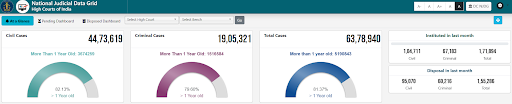
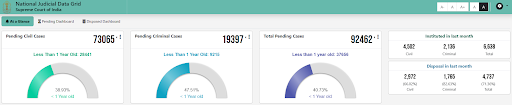
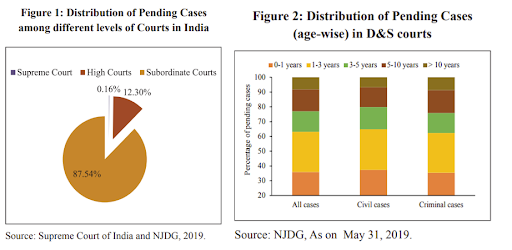
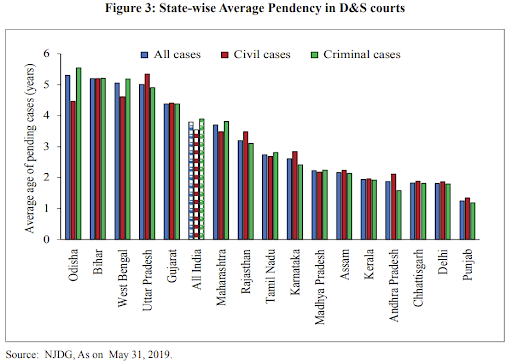
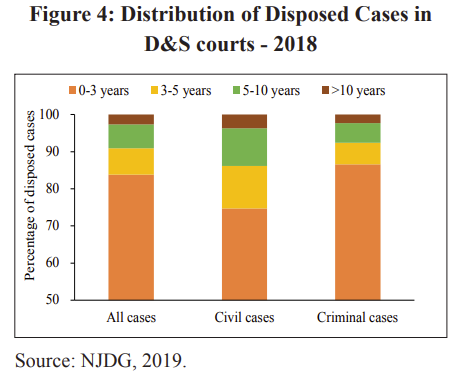
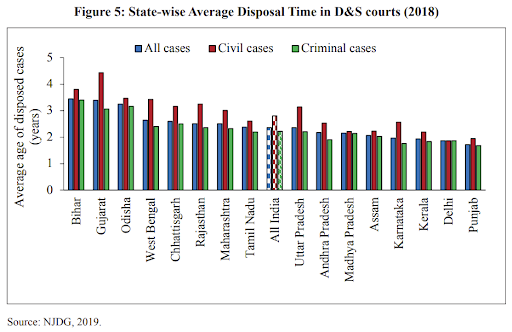
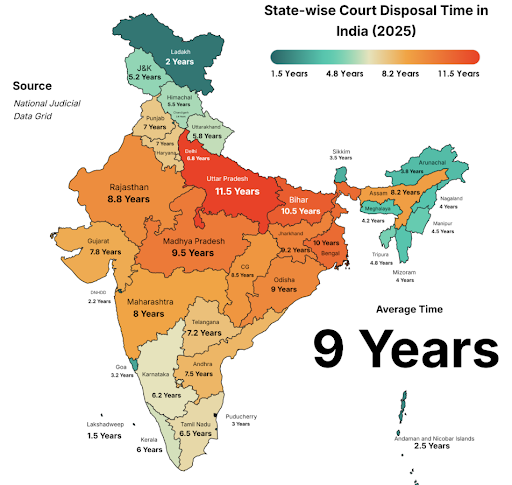
However, current data reveal that this duration of disposal has increased to an average of 9 years in subordinate courts and high courts (civil: approximately 12 years; criminal: around 7 years), representing a significant increase in case processing time. Analysis by case type for pendency reveals that 60.43% of criminal cases and 56.81% of civil cases are pending for more than 1 year, with the average pendency of all cases being around 3.5 years.17
This lengthening of judicial proceedings imposes high costs not only on the parties involved but also on the government and judges hearing such cases and can also create severe obstacles to economic development.
India’s judiciary has long faced high vacancy levels, especially in the lower courts—a concern formally acknowledged by the Supreme Court. A 2017 study by the Vidhi Centre for Legal Policy (Ranking Lower Court Appointments) found that around 2.5 crore cases were pending in the lower judiciary, with 23% of judicial posts vacant, making vacancies one of the major drivers of backlog.18
The Law Commission’s 120th Report recommended 50 judges per million people
21, yet India remains far below this benchmark. As of 2025, India Justice
22 Report India has 21,285 judges, or 15 judges per million population. Only the High Courts of Sikkim, Tripura, and Meghalaya function with a full sanctioned strength. Nationally, there is one High Court judge for 18.7 lakh people and one subordinate judge for 69,000 people.
Only eight High Courts have fewer than 10 lakh people per judge, while in others the ratio ranges from 12 lakh (Madras HC) to 38 lakh (Patna HC) per judge. At the subordinate level, Mizoram has the best ratio (1:28,022), followed by Punjab among larger states (1:43,046). In contrast, states such as Bihar, Jharkhand, Tamil Nadu, Telangana, and Uttar Pradesh exceed 70,000 people per judge, while West Bengal has a 1:100,000 ratio, one of the worst.
Though the population per judge method may not be the most optimal method to evaluate judicial requirements and DAKSH in its ‘Calculating judges strength in India’
23 suggests some models based on time and caseload (‘time-based weighted caseload method’), the model is yet to be tested and lacks performance data to study further.
Judicial workloads have escalated sharply alongside rising pendency. By 2024, most High Courts, except Sikkim, Tripura, and Meghalaya had over 1,000 cases per judge, with Allahabad and Madhya Pradesh reaching about 15,000 each. District court judges averaged 2,200 cases, with wide variation: Karnataka judges handled around 1,750 cases, Kerala 3,800, and Uttar Pradesh 4,300, while only seven states/UTs kept workloads below 300. Between 2020 and 2024, caseloads increased in thirteen High Courts, and only Bihar, Meghalaya, and Puducherry reduced workloads at the district level.
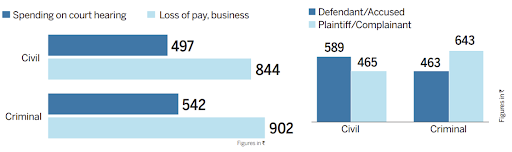
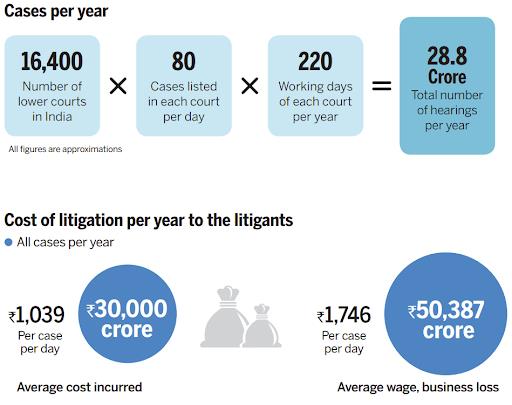
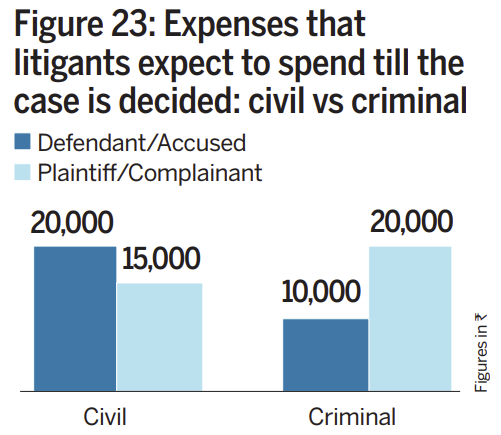
The DAKSH Access to Justice Survey in 2016 provides groundbreaking empirical evidence on the economic burden imposed on litigants by judicial inefficiency. The survey, conducted across 305 locations in 24 states with 9,000 respondents, reveals that civil litigants spend Rs 497 per day on average for court hearings and lose ₹844 per day in wages, while criminal litigants spend ₹542 per day and lose ₹902 per day. Overall, the survey estimates ₹30,000 crore in annual litigation expenses and ₹50,387 crore in wage and business losses, resulting in a total economic impact of ₹80,000 crore.29
Adjusting for inflation and wage growth from 2016 to 2024, Civil litigants spend ₹759/day on hearings and lose ₹1,288/day in wages, while criminal litigants spend ₹827 and lose ₹1,377. Productivity losses from court attendance amount to 0.48% of India’s GDP. With India’s GDP at approximately ₹295 lakh crore in 2024, this translates to ₹1.42 lakh crore in economic costs (direct litigation: ₹53,000; and productivity losses: ₹88,750 cr).30