Daksh

Search
Close this search box.
Search
Close this search box.

The Cost and Efficiency of Judiciary as a Public Good

I. Abstract

India’s judiciary, a constitutionally mandated pillar of democracy, exemplifies a pure public good characterised by non-excludability and non-rivalry. This study examines judicial efficiency as public good provision, analysing empirical data from 2018 and 2024 to document a deepening crisis in access to justice. Using data from the National Judicial Data Grid (NJDG), DAKSH database, this research reveals that despite a 43% increase in budget allocations, total case pendency has risen 59% to over 5 crore cases, average case duration to disposal has increased by almost 9 years. The annual economic costs borne by litigants are exceptionally high—estimated at approximately ₹80,000 crore in 2016—and, when adjusted for subsequent inflation and wage growth, are likely to be substantially greater today. The analysis demonstrates that 93.5% of judicial expenditure is borne by state governments and the balance by the centre. Annually, India spends an average of 0.08%, with states spending a mere 0.54% of their total expenditure.

1. Introduction ​

1.1 The Judiciary as Pillar of Democracy

There are three pillars of Indian democracy: the executive, the legislature, and the judiciary. The judiciary, as a democratic pillar, safeguards constitutional rights and ensures the rule of law by resolving disputes, guaranteeing access to justice, and providing legal certainty, which is necessary for social and economic functioning.

The judicial system has witnessed radical changes over recent decades, with both supply and demand sides experiencing substantial growth. According to the National Judicial Data Grid, as of December 2025, India’s judiciary manages over 5 crore pending cases across all tiers of  Courts. This represents a critical challenge to the fundamental promise of timely justice delivery.

1.2 Judiciary as Public Good: Theoretical Framework

A public good is defined by two key characteristics: non-excludability, wherein no individual can be excluded from consuming the good regardless of payment, and non-rivalry, wherein one person’s consumption does not reduce availability for others. The government produces public goods where private firms cannot and where the provision of such goods is necessary for equity and efficiency.

While economists in India often prioritise education and healthcare as key public goods that require investment, the judiciary is often overshadowed, despite its critical role in supporting sustained economic growth. An effective judicial system not only resolves disputes but also deters unlawful behaviour, making it essential for a well-functioning economy and society.

1.2.1 Non-Excludability of Judicial Services

The judiciary exhibits non-excludability as a constitutional institution mandated to deliver justice independently of government influence. Its services are inherently accessible—one person filing a case does not impede another from doing so. Reflecting this, the Department of Justice reports a substantial expansion in the number of courts across India, ensuring broad access to judicial services from rural areas to major urban centres.

The judiciary promotes mass justice through mechanisms, including Public Interest Litigations (PILs), writ petitions, and suo moto actions, imposing no rationing or restrictions on the number of cases that an individual or firm can file, nor restrictions on total cases filed. The concept of public good in the judiciary would encompass its availability to all, including any conditions that may be prescribed for its availability, such as limitations, jurisdiction, etc. This ensures equal opportunity for all to seek judicial remedies, with no exclusions from the system’s reach.

1.2.2 Non-Rivalry in Justice Delivery

Filing a case by one individual does not diminish the benefit others receive from accessing the courts, as judicial remedies remain fully available to all. Case outcomes likewise do not reduce the value of judicial services for others. Moreover, the use of precedents generates positive externalities, as past judgments improve the quality and consistency of justice for future litigants.

2. EMPIRICAL EVIDENCE

2.1 The Deepening Crisis

2.1.1 Aggregate Pendency Trends

Between June 2008 and December 2018, case pendency increased from  37,78,715 cases to 44,48,899 cases in High Courts alone, representing an 18% increase. When examining the pendency in the complete judicial hierarchy from 2018 to 2024, the crisis becomes even more apparent.


Table 1: Pendency Across Judicial Hierarchy (2018 vs 2024)

Court Level 2018 Pending9 2024 Pending Change %
Supreme Court 57,346 82,33610 +43.58%
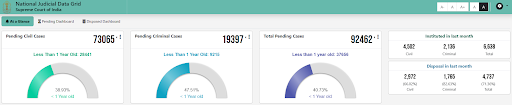
High Courts 44,48,899 58,59,74911 +31.71%
District/Subordinate 3,00,03,895 4,49,40,44913 +49.78%
TOTAL 3,45,10,140 5,08,82,534 +47.44%

Pendency has risen 47.44% (1.6 cr) over six years, despite expanded infrastructure and budgets, with District Courts experiencing the highest increase of 49.78%, highlighting critical appellate bottlenecks.

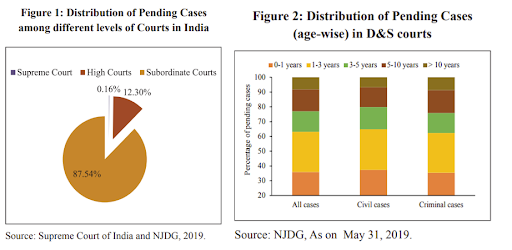
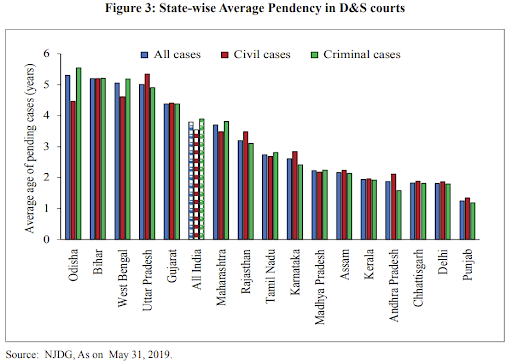
In the report by DAKSH ‘ Deconstructing delay, 2017, Average Pendency in All High Courts and Subordinate Courts’,  in 2017, it was reported that average pendency in high courts is 3 years and that in subordinate courts is 6 years. More than 64 per cent of all cases are pending for more than one year as per the Economic Survey 2018-19.


2.2.2 Average Case Duration: The Delay Crisis

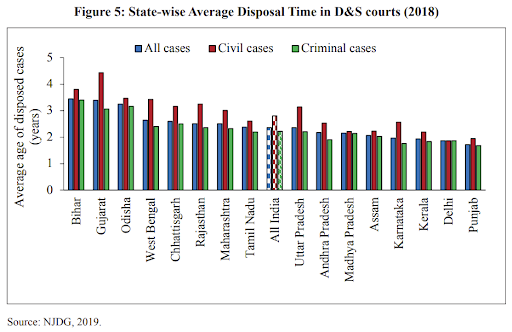
A study by DAKSH in 2017, where 3 million cases across 3000 subordinate courts were analysed revealed that it took an average of 5 months for a case to be heard for the first time and 15 months to dispose of. In another DAKSH report in 2017, it was reported that the average disposal of execution cases is 4 years. In Delhi High Court, the average disposal was 2 years.

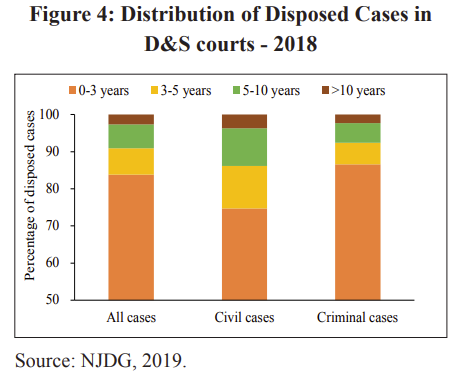
In the Economic Survey 2018-19, it was noted that 74.7 per cent of the civil cases and 86.5 per cent of the criminal cases are disposed of within three years. Complications in civil cases, such as cumbersome procedures and complex cases, can cause delays.

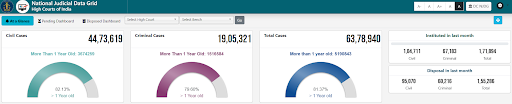
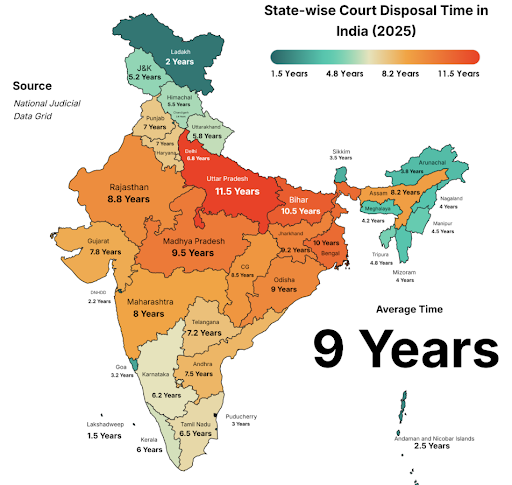
However, current data reveal that this duration of disposal has increased to an average of 9 years in subordinate courts and high courts (civil: approximately 12 years; criminal: around 7 years), representing a significant increase in case processing time. Analysis by case type for pendency reveals that 60.43%  of criminal cases and 56.81% of civil cases are pending for more than 1 year, with the average pendency of all cases being around 3.5 years.

This lengthening of judicial proceedings imposes high costs not only on the parties involved but also on the government and judges hearing such cases and can also create severe obstacles to economic development.

2.2. THE JUDICIAL VACANCY CRISIS

2.2.1 Historical Vacancy Trends

India’s judiciary has long faced high vacancy levels, especially in the lower courts—a concern formally acknowledged by the Supreme Court. A 2017 study by the Vidhi Centre for Legal Policy (Ranking Lower Court Appointments) found that around 2.5 crore cases were pending in the lower judiciary, with 23% of judicial posts vacant, making vacancies one of the major drivers of backlog.

As per Court News, 201819,

Court Level Sanctioned
Strength
Working
Strength
Vacancies Vacancy
%
Supreme Court 31 23 8 26%
High Courts 1,079 670 409 38%
District/Subordinate 22,772 17,643 5,129 23%
TOTAL 23,882 18,336 5,546 23%

As of 202420, the vacancy rate was as below:

Court Level Sanctioned
Strength
Working
Strength
Vacancies Vacancy
%
Supreme Court 34 33 1 3%
High Courts 1,122 754 368 33%
District/Subordinate 25,741 20,479 5,262 20%
TOTAL 26,897 21,266 5,631 21%

With an increase in instituted and pending cases, this vacancy burden falls disproportionately on the limited number of serving judges.

2.2.2 Population per Judge and Workload Analysis

The Law Commission’s 120th Report recommended 50 judges per million people, yet India remains far below this benchmark. As of 2025, India Justice Report India has 21,285 judges, or 15 judges per million population. Only the High Courts of Sikkim, Tripura, and Meghalaya function with a full sanctioned strength. Nationally, there is one High Court judge for 18.7 lakh people and one subordinate judge for 69,000 people.

Only eight High Courts have fewer than 10 lakh people per judge, while in others the ratio ranges from 12 lakh (Madras HC) to 38 lakh (Patna HC) per judge. At the subordinate level, Mizoram has the best ratio (1:28,022), followed by Punjab among larger states (1:43,046). In contrast, states such as Bihar, Jharkhand, Tamil Nadu, Telangana, and Uttar Pradesh exceed 70,000 people per judge, while West Bengal has a 1:100,000 ratio, one of the worst.

Though the population per judge method may not be the most optimal method to evaluate judicial requirements and DAKSH in its ‘Calculating judges strength in India’ suggests some models based on time and caseload (‘time-based weighted caseload method’), the model is yet to be tested and lacks performance data to study further.

Judicial workloads have escalated sharply alongside rising pendency. By 2024, most High Courts, except Sikkim, Tripura, and Meghalaya had over 1,000 cases per judge, with Allahabad and Madhya Pradesh reaching about 15,000 each. District court judges averaged 2,200 cases, with wide variation: Karnataka judges handled around 1,750 cases, Kerala 3,800, and Uttar Pradesh 4,300, while only seven states/UTs kept workloads below 300. Between 2020 and 2024, caseloads increased in thirteen High Courts, and only Bihar, Meghalaya, and Puducherry reduced workloads at the district level.


2.3. Impact on Efficiency Due to Absenteeism of Lawyers

The judiciary, like any other sector, suffers significantly from employee absenteeism—in this case, the absence of lawyers from courtrooms. While litigants cannot be denied the right to present their case even when defendants are not present, the survey conducted by DAKSH India (2016) revealed that a clear majority of respondents strongly felt that delays in cases were caused by the absenteeism of the other party. This finding reflects the low trust litigants have in the judiciary’s ability to provide timely justice.

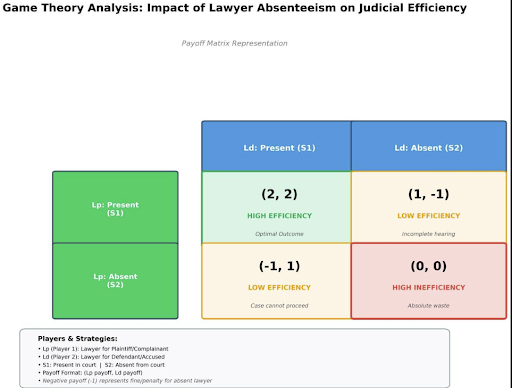
To understand how absenteeism reduces efficiency, we can employ game theory. Assume that the judge is always present and fully productive, delivering efficient outcomes. The players in this game are the lawyer for the plaintiff (or complainant), denoted as Lp (player 1), and the lawyer for the defendant (or accused), denoted as Ld (player 2). Each lawyer has two strategies: to be present in court (S1) or to be absent (S2). The payoff from being present is an efficient judicial outcome. The game can be represented in a payoff matrix. When both Lp and Ld are present (S1=S1), high efficiency is attained—this is the optimal solution to the problem of inefficiency. When one lawyer is absent while the other is present, low efficiency results. If Ld is absent, Lp may still present before the court, but the outcome will be inefficient as the judge cannot render judgment without hearing the defence or other party to the case. Conversely, if Lp is absent, the court cannot proceed with the case despite Ld’s presence. This leads to inefficiency, wasted court time and resources, and additional costs for the party whose lawyer is present. The present lawyer typically faces a negative payoff (-1) in the form of a cost or travelling fee. When both lawyers are absent (S2=S2), high inefficiency prevails—the judge cannot render any judgment, resulting in absolute inefficiency and a complete waste of judicial time and resources. Thus, lawyer absenteeism not only reduces judicial efficiency but also increases costs for the parties involved and creates implicit costs for the judiciary, such as mounting pending cases and lost time.


2.4 THE BUDGET PARADOX

The Union Budget for 2024-25 allocated ₹6,788.33 crore to the Ministry of Law and Justice, of which ₹5,940.95 crore supports departments of law and justice, ₹525.49 crore for the Supreme Court of India, and ₹321.89 crore for the Election Commission. This represents a 50% increase from the 2017-18 allocation of ₹4,536.66 crore. As of 2015, the 13th Finance Commission provided a ₹5,000-crore grant (2010–2015) to strengthen the judiciary, but only about 20% was utilised. In recent years, utilisation has improved significantly to around 95–98% for most schemes and grants. Union budget allocations have also been used more efficiently: the 2025 Budgets for Justice study reports 86% utilisation for subordinate courts, 85% for fast-track special courts, and 90% for advocate general offices in 2022–23.
But with the increase in allocation and utilisation, the logical expectation is that efficiency ought to have improved, but to the contrary, has become more inefficient, as seen in previous sections, the average time taken to disposal has increased from 4 to 9 years; thereby significantly increasing costs incurred along with it. The number of cases pending disposal has also increased, though one side of the coin might state that if the numbers have increased, then the judiciary is more accessible. It is pointed out that such a claim can only be substantiated if there is a correlative decrease in time taken to disposal.


2.5 THE ECONOMIC BURDEN OF JUDICIAL INEFFICIENCY​

2.5.1 Direct Costs to Litigants​

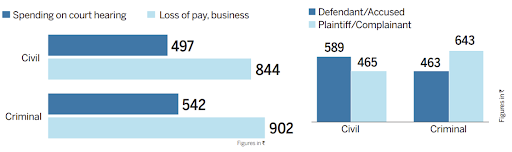
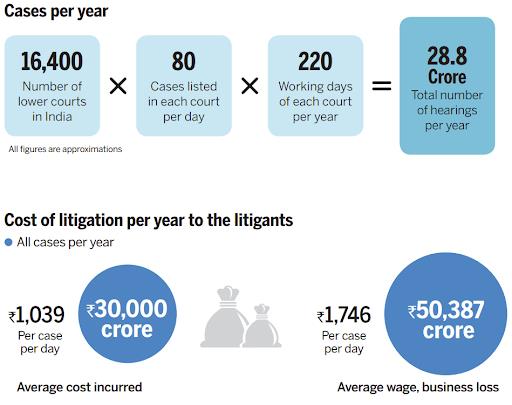
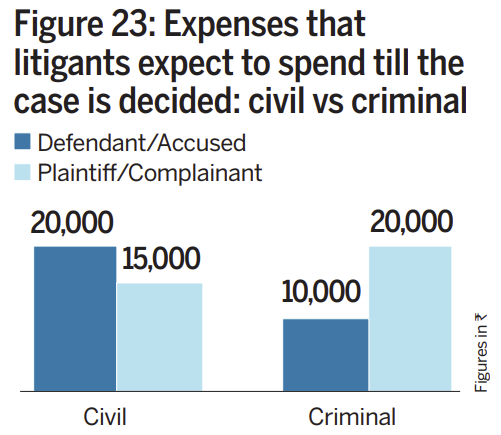
The DAKSH Access to Justice Survey in 2016 provides groundbreaking empirical evidence on the economic burden imposed on litigants by judicial inefficiency. The survey, conducted across 305 locations in 24 states with 9,000 respondents, reveals that civil litigants spend Rs 497 per day on average for court hearings and lose ₹844 per day in wages, while criminal litigants spend ₹542 per day and lose ₹902 per day. Overall, the survey estimates ₹30,000 crore in annual litigation expenses and ₹50,387 crore in wage and business losses, resulting in a total economic impact of ₹80,000 crore.

Adjusting for inflation and wage growth from 2016 to 2024, Civil litigants spend ₹759/day on hearings and lose ₹1,288/day in wages, while criminal litigants spend ₹827 and lose ₹1,377. Productivity losses from court attendance amount to 0.48% of India’s GDP. With India’s GDP at approximately ₹295 lakh crore in 2024, this translates to ₹1.42 lakh crore in economic costs (direct litigation: ₹53,000; and productivity losses: ₹88,750 cr).

2.5.2 Income-Level Disparities in Cost Burden​

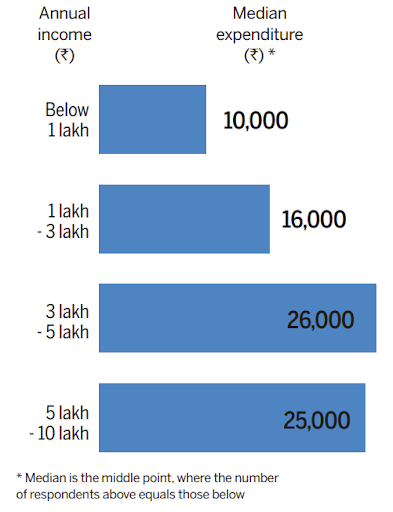
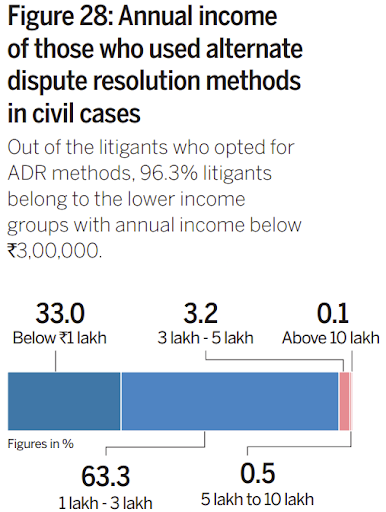
Judicial inefficiency imposes a regressive economic burden, disproportionately affecting low-income litigants. According to DAKSH’s Access to Justice survey, litigants earning under ₹1 lakh spend nearly 10% of their income on litigation, while higher-income groups (₹5–10 lakh) spend only 3–5%. Consequently, 96.3% of litigants with annual incomes below ₹3 lakh choose alternative dispute resolution (ADR) mechanisms in civil matters to avoid these high costs. This disparity highlights how litigation expenses and the opportunity cost of court attendance weigh far more heavily on daily-wage and informal workers than on salaried or financially secure individuals.

3. PUBLIC GOOD THEORY AND SYSTEMIC INEFFICIENCY​

3.1 The Residual Claimant Problem​

In private goods markets, residual claimants—typically owners or shareholders—possess strong incentives to maximise efficiency because they capture the benefits of improved performance. In public goods provision, such as the judiciary, this mechanism breaks down. The absence of effective residual claimants creates a fundamental problem as citizens and litigants who bear costs but cannot directly capture efficiency gains. In the judicial system, citizens are residual claimants—they absorb all the accumulated costs of institutional failures across all layers of the judiciary.

3.2 Judiciary Not so public good ? ​

The essentials of a Public good as discussed above, are two in nature: non-exclusive and non-rivalrous. The institutional inefficiencies arising due to non-optimal policies and structure pave the way to a detrimental end result of judicial institutions losing their non-exclusive character of a public good. This is so because delays deny efficient provision of justice so as to become unavailable not in literal sense but in practice to citizens upon existing pending volume of cases, as the saying goes “Justice delayed is justice denied” it is more so true when it changes the essential characteristic of judiciary being a public good and what loses public good character only increases in cost.

4. WAY FORWARD - REFORMATIVE FRAMEWORK

The reform strategy spans immediate, medium-term, and long-term measures aimed at restoring judicial efficiency. Short-term priorities (0–2 years) include legislated time limits for case disposal, deterrence of frivolous litigation through a modified “loser pays” model, and strict enforcement of lawyer attendance. Medium-term reforms (2–5 years) focus on achieving full judicial strength through faster appointments, expanding ADR, especially compulsory mediation, completing digital transformation with e-filing and AI-enabled case management, and overhauling procedures for faster case flow. Long-term structural reforms (5+ years) propose performance-based judicial management, output-linked budgeting under an independent Judicial Finance Commission, transparent and accountable judicial governance, including collegium reform, and a significant reduction of government-driven litigation through mandatory reviews and settlement mechanisms. It shall also be viable for the incorporation of AI-driven agents in executive functioning in order to restrict frivolous litigation arising out of bureaucratic incompetence, such that public institutions, such as the judiciary at large remains public. 

1 Sanjay Dutta, “ Claims worth millions stuck as power tribunal clears just 49 cases in 2 years”, Times of India (New Delhi), February 6, 2024,
https://timesofindia.indiatimes.com/city/delhi/claims-worth-millions-stuck-as-power-tribunal-clears-just-49-cases-in-2-years/articleshow/107442255.cms, accessed November 25, 2025
2 The Electricity Act, 2003, s 111, available at: https://www.indiacode.nic.in/show-data?actid=AC_CEN_19_22_00001_200336_1517807317930&orderno=111

3 Sanjay Dutta, “ Power sector sees 70% rise in backlog of disputes”, Times of India (New Delhi), February 7, 2024,
https://timesofindia.indiatimes.com/business/india-business/power-sector-sees-70-rise-in-backlog-of-disputes/articleshow/107440985.cms, accessed November 16, 2025
4 Sanjay Dutta, “Rising Case Backlog in APTEL: Concerns for Power Sector”, Times of India (New Delhi), February 5, 2024, https://timesofindia.indiatimes.com/india/rising-case-backlog-in-aptel-concerns-for-power-sector/articleshow/107437134.cms, accessed November 16, 2025
5 DAKSH, State of Tribunals Report 2025 (2025) pg 184
https://www.dakshi ndia.org/wp-content/uploads/2025/09/State-of-Tribunals-PDF-Digital.pdf
6 Ibid
7 The Electricity Act, 2003, s 111, available at: https://www.indiacode.nic.in/show-data?actid=AC_CEN_19_22_00001_200336_1517807317930&orderno=111
8 DAKSH, State of Tribunals Report 2025 (2025), pg 183
https://www.dakshi ndia.org/wp-content/uploads/2025/09/State-of-Tribunals-PDF-Digital.pdf
9Maria Chirayil & Shantanu Dixit & Ann Josey, Vacancies at the APTEL: A persistent problem of delayed appointments (2023)
https://energy.prayaspune.org/power-perspectives/vacancies-at-the-aptel-a-persistent-problem-of-delayed-appointments
10Maria Chirayil & Shantanu Dixit & Ann Josey, Vacancies at the APTEL: A persistent problem of delayed appointments (2023)
https://energy.prayaspune.org/power-perspectives/vacancies-at-the-aptel-a-persistent-problem-of-delayed-appointments
11DAKSH, State of Tribunals Report 2025 (2025), pg 186
https://www.dakshi ndia.org/wp-content/uploads/2025/09/State-of-Tribunals-PDF-Digital.pdf
12Trustbridge, Return to Sender: The misuse of remand orders by appellate tribunals
https://trustbridge.in/RePEc/papers/2025_Aggarwaletal_Remands.pdf
13 Chitrakshi Jain & Bhavin Patel &Renuka Sane,”Examining the performance of ERCs at APTEL”(2025), The Leap Blog, Available at:
https://blog.theleapjournal.org/2025/07/examining-performance-of-ercs-at-aptel.html#gsc.tab=0
14 Corporate Insolvency Resolution Processes Yielding Resolution Plans as on 31st March, 2025. July 30, 2025. https://ibbi.gov.in/en/claims/cd-summary.


SHARE

© 2021 DAKSH India. All rights reserved

Powered by Oy Media Solutions

Designed by GGWP Design

+ posts