

Daksh

Search
Close this search box.

Appellate Review of Expert Regulators: Deference, Jurisdiction, and Scope

I. Abstract

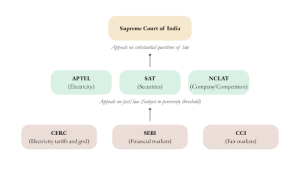
India’s regulatory appellate architecture rests on a foundational but underarticulated premise that appellate review of expert regulatory decisions should be corrective rather than substitutive. This article traces the emergence and cross-sector consolidation of what it terms the doctrine of structured deference, an approach to appellate scrutiny that neither immunises specialist regulators from oversight nor permits appellate tribunals to freely displace expert economic and technical judgment with their own. Drawing on Supreme Court jurisprudence spanning electricity (APTEL), securities (SAT), telecommunications (TDSAT), competition (COMPAT/NCLAT), and environmental law (NGT), the article identifies a consistent institutional philosophy across otherwise disparate statutory regimes. Appellate tribunals are positioned to ensure legality, rationality, and evidentiary integrity. Several doctrinal markers give this balance its operative content: the uniform prohibition on tribunals adjudicating constitutional validity, the confinement of Supreme Court appeals to substantial questions of law, the perversity threshold for factual intervention, and the distinction, most clearly drawn in Excel Crop Care, between substantive regulatory findings and the legal characterisation of remedies. The article further identifies structural tensions that the doctrine leaves unresolved, including the dilution of specialist competence occasioned by the NCLAT’s multi-sector mandate, inter alia.   Modern regulatory governance distributes decision making across specialised agencies designed to possess technical competence and sector-specific expertise. Electricity regulators evaluate tariff structures and grid stability. Securities regulators oversee complex financial markets. Competition authorities analyse market power, counterfactuals, and economic theories of harm. These institutions operate in domains where legal reasoning must often be interwoven with technical knowledge, economic modelling, and forward-looking predictions. In such settings, appellate review presents a recurring institutional dilemma. If appellate bodies are too deferential, expert regulators risk operating without meaningful accountability. If appellate bodies freely substitute their own judgments, the value of regulatory expertise itself becomes undermined. The challenge is therefore not simply whether review should exist, but how it should be structured. Across multiple regulatory sectors in India, the Supreme Court’s jurisprudence, as discussed below, suggests the gradual emergence of what may be described as a doctrine of structured deference. This approach rejects both blind deference and unrestricted merits substitution. Instead, appellate tribunals are positioned as corrective institutions that ensure legality, rationality, and evidentiary integrity without displacing expert regulatory judgment except in defined circumstances. Although this doctrine has never been formally articulated as a unified principle, its contours become visible when one examines the Court’s decisions across electricity, securities, telecommunications, competition, and environmental regulation. Despite differences in statutory frameworks, a common institutional philosophy appears to guide the relationship between regulators and appellate bodies.

II. The Institutional Logic of Structured Deference

The central premise underlying structured deference is that expert regulators occupy the primary decision-making role within their respective sectors. Their decisions are presumed to draw upon specialised knowledge that courts and tribunals may not possess to the same degree. Appellate oversight is therefore designed to operate as a safeguard rather than as a substitute regulatory forum.

The Supreme Court has developed, across electricity and telecommunications decisions, a framework governing expert regulators and reviewing courts. Its premise is that regulatory bodies draw upon technical, economic, and policy expertise that courts cannot replicate, and that appellate oversight therefore operates as a safeguard against illegality and irrationality, not as a substitute regulatory forum. The foundations were laid in West Bengal Electricity Regulatory Commission v. CESC Ltd. (2002) where the Calcutta High Court, hearing a tariff appeal, had re-determined the tariff itself. The Supreme Court reversed this, holding that courts could not ordinarily interfere with expert findings absent illegality or infirmity. Justice Santosh Hegde’s observations at Para 102, that technical regulatory disputes required a multi-disciplinary expert appellate body, directly inspired the creation of APTEL under the Electricity Act, 2003. The same principle was reinforced in Transmission Corporation of Andhra Pradesh Ltd. v. APERC, where the Court held that regulatory jurisdiction over transmission necessarily carried the authority to fix wheeling charges, and that courts could not supplant expert determinations without engaging with the materials before the regulator.

The second structural boundary was drawn by the Court in PTC India Ltd. v. CERC (2010). The Court held that APTEL’s appellate jurisdiction extended to disputes about the interpretation of CERC regulations, but that challenges to their validity lay only before constitutional courts exercising judicial review. Tribunals review regulatory orders; constitutional courts supervise regulatory rulemaking.

The deference embedded in this framework is nonetheless conditional. In Cellular Operators Association of India v. TRAI (2016), the Court struck down a TRAI call-drop compensation regulation as exceeding the scope of the TRAI Act. Strong presumptive validity attaches to expert regulatory decisions, but yields where a regulator has acted outside its statutory mandate or in a manifestly arbitrary manner. The permissible grounds for displacing regulatory judgment are therefore confined to legality and rationality, and not disagreement with the regulatory outcome itself.

III. Doctrinal Markers of the Framework

Taken together, the jurisprudence across sectors reveals several recurring doctrinal markers that give operational content to structured deference.

First, appellate bodies consistently lack jurisdiction to adjudicate constitutional validity of regulatory instruments. Whether in the electricity sector, telecommunications, or competition law, constitutional challenges must be brought before constitutional courts. This preserves a hierarchical separation between statutory appeals and judicial review.

Second, appeals to the Supreme Court from specialised tribunals are typically confined to substantial questions of law. This statutory design reinforces the limited scope of further appellate scrutiny. The Court’s role is not to revisit factual determinations or economic evaluations except where they raise legal issues of systemic importance.

Third, intervention in factual findings is generally conditioned upon the perversity threshold. Appellate bodies may correct findings that are unsupported by evidence, based on manifest misunderstanding of the record, or otherwise irrational. However, mere disagreement with the regulator’s interpretation of the evidence does not suffice.

Fourth, the jurisprudence distinguishes between substantive regulatory findings and the legal characterisation of remedies. The Excel Crop Care decision exemplifies this distinction. While the Court refrained from revisiting the underlying findings of cartelisation, it scrutinised the statutory basis of the penalty methodology. This separation permits courts to ensure legal coherence without displacing expert fact-finding.

IV. Emerging Structural Tensions

Despite its coherence, the doctrine of structured deference also reveals certain unresolved tensions within India’s regulatory appellate architecture.

One tension arises from the institutional design of appellate tribunals themselves. Historically, sector-specific tribunals such as APTEL and the Securities Appellate Tribunal (SAT) developed domain expertise aligned with their respective regulatory regimes. By contrast, the NCLAT now exercises appellate jurisdiction over a diverse set of statutes, including competition law, insolvency law, and company law. This multi-sector mandate risks diluting the specialist competence that structured deference presupposes. If appellate tribunals lack comparable expertise to the regulators whose decisions they review, the equilibrium between expertise and oversight becomes harder to maintain. The appellate forum may either defer excessively due to unfamiliarity with the regulatory domain or intervene unpredictably without sufficient technical grounding.

A second tension concerns the increasing complexity of digital and networked markets. Regulatory decisions in such environments often involve probabilistic reasoning, algorithmic governance, and dynamic theories of competitive harm. These characteristics make it more difficult to distinguish between factual findings, economic modelling, and normative policy choices. Appellate scrutiny must therefore navigate increasingly blurred boundaries between law and economics.

Finally, the doctrine itself remains underarticulated in Indian jurisprudence. Courts frequently apply its elements in individual cases without explicitly recognising them as part of a coherent institutional philosophy. As a result, the principles guiding appellate restraint and intervention are often inferred rather than systematically articulated.

V. Conclusion

India’s regulatory state has gradually developed a layered system of specialised agencies and appellate tribunals. Within this system, the Supreme Court’s jurisprudence suggests the emergence of a pragmatic doctrine of structured deference. The doctrine recognises that expert regulators must retain primary authority over technical and economic judgments, while appellate institutions ensure legality, rationality, and evidentiary integrity.

This framework rejects both extremes of regulatory insulation and judicial substitution. Instead, it constructs a calibrated relationship between expertise and oversight through doctrinal markers such as the perversity threshold, the confinement of appeals to questions of law, and the separation between statutory appeals and constitutional review.

Yet the doctrine remains incomplete. Institutional changes such as the consolidation of appellate jurisdiction within the NCLAT and the growing complexity of digital markets raise new questions about how expertise and accountability should be balanced. Whether structured deference will evolve into a more explicit and stable principle of Indian regulatory law remains an open question. What is clear, however, is that the architecture of appellate review continues to shape the effectiveness and legitimacy of India’s specialised regulatory institutions.

SHARE

RECENT ARTICLES

© 2021 DAKSH India. All rights reserved

Powered by Oy Media Solutions

Designed by GGWP Design

+ posts