

India’s regulatory appellate architecture rests on a foundational but underarticulated premise that appellate review of expert regulatory decisions should be corrective rather than substitutive. This article traces the emergence and cross-sector consolidation of what it terms the doctrine of structured deference, an approach to appellate scrutiny that neither immunises specialist regulators from oversight nor permits appellate tribunals to freely displace expert economic and technical judgment with their own. Drawing on Supreme Court jurisprudence spanning electricity (APTEL), securities (SAT), telecommunications (TDSAT), competition (COMPAT/NCLAT), and environmental law (NGT), the article identifies a consistent institutional philosophy across otherwise disparate statutory regimes. Appellate tribunals are positioned to ensure legality, rationality, and evidentiary integrity. Several doctrinal markers give this balance its operative content: the uniform prohibition on tribunals adjudicating constitutional validity, the confinement of Supreme Court appeals to substantial questions of law, the perversity threshold for factual intervention, and the distinction, most clearly drawn in Excel Crop Care, between substantive regulatory findings and the legal characterisation of remedies. The article further identifies structural tensions that the doctrine leaves unresolved, including the dilution of specialist competence occasioned by the NCLAT’s multi-sector mandate, inter alia.
Modern regulatory governance distributes decision making across specialised agencies designed to possess technical competence and sector-specific expertise. Electricity regulators evaluate tariff structures and grid stability. Securities regulators oversee complex financial markets. Competition authorities analyse market power, counterfactuals, and economic theories of harm. These institutions operate in domains where legal reasoning must often be interwoven with technical knowledge, economic modelling, and forward-looking predictions.
In such settings, appellate review presents a recurring institutional dilemma. If appellate bodies are too deferential, expert regulators risk operating without meaningful accountability. If appellate bodies freely substitute their own judgments, the value of regulatory expertise itself becomes undermined. The challenge is therefore not simply whether review should exist, but how it should be structured.
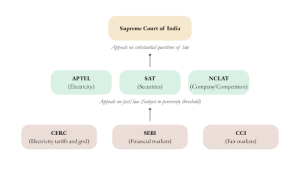 Across multiple regulatory sectors in India, the Supreme Court’s jurisprudence, as discussed below, suggests the gradual emergence of what may be described as a doctrine of structured deference. This approach rejects both blind deference and unrestricted merits substitution. Instead, appellate tribunals are positioned as corrective institutions that ensure legality, rationality, and evidentiary integrity without displacing expert regulatory judgment except in defined circumstances.
Although this doctrine has never been formally articulated as a unified principle, its contours become visible when one examines the Court’s decisions across electricity, securities, telecommunications, competition, and environmental regulation. Despite differences in statutory frameworks, a common institutional philosophy appears to guide the relationship between regulators and appellate bodies.
Across multiple regulatory sectors in India, the Supreme Court’s jurisprudence, as discussed below, suggests the gradual emergence of what may be described as a doctrine of structured deference. This approach rejects both blind deference and unrestricted merits substitution. Instead, appellate tribunals are positioned as corrective institutions that ensure legality, rationality, and evidentiary integrity without displacing expert regulatory judgment except in defined circumstances.
Although this doctrine has never been formally articulated as a unified principle, its contours become visible when one examines the Court’s decisions across electricity, securities, telecommunications, competition, and environmental regulation. Despite differences in statutory frameworks, a common institutional philosophy appears to guide the relationship between regulators and appellate bodies.
Across multiple regulatory sectors in India, the Supreme Court’s jurisprudence, as discussed below, suggests the gradual emergence of what may be described as a doctrine of structured deference. This approach rejects both blind deference and unrestricted merits substitution. Instead, appellate tribunals are positioned as corrective institutions that ensure legality, rationality, and evidentiary integrity without displacing expert regulatory judgment except in defined circumstances.
Although this doctrine has never been formally articulated as a unified principle, its contours become visible when one examines the Court’s decisions across electricity, securities, telecommunications, competition, and environmental regulation. Despite differences in statutory frameworks, a common institutional philosophy appears to guide the relationship between regulators and appellate bodies.