


Daksh

Search
Close this search box.
Search
Close this search box.

CIIRP: A New Approach against the core principles of IBC

I. Abstract

The Insolvency and Bankruptcy Code (IBC) was built upon the recommendations of the BLRC committee led by TK Vishwanathan. The Code’s core principles include time bound resolution, creditor-in-control process and swift resolution1. However, the proposed Insolvency And Bankruptcy (Amendment) Bill, 2025, introduces the Creditor Initiated Insolvency Resolution Process(CIIRP) which pivots back to the debtor-in-control  model with some checks and balances2. History shows that debtor-in control model was followed in SICA and led to excessive delays and severe value destruction by allowing defaulting promoters and existing management to remain in control3. While CIIRP is proposed to save time with a 150 day deadline extendable by 45 days and if it does not yield results it is to be converted to regular CIRP. This would just extend the timeline more as, if the CIIRP fails it would get an additional timeline of 330 days. This model does not better the timeline if thought from a worst case scenario point of view as we have seen in the Pre Packaged Insolvency model. The Blog aims to point out the structural issues that the new model proposes.

II. Introduction

The enactment of Insolvency and Bankruptcy Code (IBC), 2016 has been a landmark reform in India’s economic history4. It replaced a fragmented, debtor-leaned regime regime with a streamlined, creditor-led framework with minimal judicial interference. The Insolvency and Bankruptcy Code (Amendment) Bill, 20255, seeks to introduce a new mechanism named Creditor-Initiated Insolvency Resolution Process(CIIRP)6. Before the IBC, the primary legislation for financially distressed companies was the Sick Industrial Companies (Special Provisions) Act, 1985 (SICA)7. SICA was based on the Debtor-in-Possession model, in which existing management and promoters stayed in control of the company while the Board for Industrial and Financial Reconstruction (BIFR) attempted to revive it. The Report of the Committee on Industrial Sickness and Corporate Restructuring chaired by Omkar Goswami suggested that the failure of SICA could be attributed to the debtor-in-possession model8. Promoters often used the stay as a shield from creditors rather than for restructuring. CIIRP proposes a debtor in possession model. By allowing the debtor to stay in control, CIIRP risks re-introducing Information Failure9. When the existing management controls the records, the Resolution Professional and the Committee of Creditors (CoC) often struggle to get a true picture of the company’s health, leading to undervalued resolution plans. The transition from a Debtor-in-Possession to a Creditor-in-Control model is not merely a procedural change, but change in one of the main principles under which the Insolvency and Bankruptcy Code (IBC), 2016 was made by the Bankruptcy and Law Reforms Committee.
III. What is CIIRP?

The IBC (Amendment) Bill, 202510 (introduced in the Lok Sabha on August 12, 2025) proposed to  insert the Chapter IV-A (Sections 58A to 58K). In the chapter a new mechanism named CIIRP is introduced. CIIRP is designed as an out of court mechanism unlike the standard Corporate Insolvency Resolution Process.
  1. Initiation and Eligibility: This process may be initiated only by financial creditors and that too by only select financial institutions specified by the central government.  It is unclear why some financial institutions should have a priority over others.
  2. Management: Unlike Section 17 of the IBC11 (where the Board is suspended), under the proposed Section 58G of the bill, the Board of Directors of the Corporate Debtor continues to manage day-to-day operations.The debtor remains in control of the business, subject to oversight by an RP who has veto power over certain board resolutions.
  3. Timeline: A 150 day window, extendable by 45 days by Committee of Creditors (CoC) as a one-time extension if approved by 66% votes.
  4. Fall Back Clause: Under Section 58J of the bill, if a resolution plan is not approved within this 195 day window (including extension), the process does not end in liquidation. Instead, it can be converted into a regular CIRP, where the Creditor-in-Control model takes over immediately and a fresh timeline is started.

IV. CIIRP: Timelines and Risk of Failure

The intent for the CIIRP is to save about a year by reducing the time now consumed in securing NCLT admission of an insolvency case, while also providing more flexibility and minimising court interventions in the process12. However, if we analyse current trends alongwith the proposed changes in the IBC (Amendment) Bill, 2025, reveals that instead of a fast track, CIIRP may create a double-layered delay that extends the resolution timeline by more than a year.

V. The Worst Case Timeline

The IBC currently mandates a maximum of 330 day limit for the completion of the CIRP under Section 12 of IBC13. CIIRP is proposed as a leaner, 150-day alternative. However, the legislation includes a conversion mechanism into CIRP rather than a liquidation.
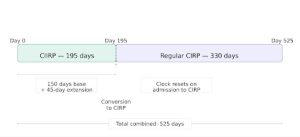
  • The CIIRP: The process lasts 150 days, plus a 45-day extension (195 days total).
  • The Conversion to CIRP: If CIIRP fails to produce a resolution plan, the financial creditors must move to convert the process into a regular CIRP.
  • The Reset CIRP: Upon conversion, the clock effectively resets. The 330-day statutory limit for regular CIRP begins from the date of admission into the new process.
  • The Combined Timeline: 195 days (CIIRP)+330 days (CIRP)=525 days.
Figure1: CIIRP Timeline This calculation includes the statutory timelines while the actual average timeline for CIRP stands at 713 days14. According to this timeline the overall process of CIIRP would go over 900 days which would add onto existing delays than to cumber it.

VI. The PPIRP Precedent: A Warning

The concerns regarding CIIRP are not just theoretical, but are through observations of failure of the Pre-Packaged Insolvency Resolution Process (PPIRP) introduced for MSMEs in 202115. According to Economic Survey 2025-26, the adoption of PPIRP has been abysmally low, just 14 cases in more than 4 years16. The reasons for this failure, which CIIRP is likely to replicate, include:
  • Trust Deficit between Creditor and Debtor: 
Creditors are often unwilling to leave defaulting promoters  and existing management in control (the Debtor-in-Possession model) during the negotiation phase.
  • Asset Deterioration:
 As highlighted by the BLRC Report (2015), the longer a debtor stays in control during insolvency, the more the asset value erodes or debtor uses assets in deploying assets in more risky ventures, making the Insolvency Resolution Process less likely to result in a successful recovery17.

VII. Conclusion

While the goal of reducing delays and NCLT backlogs is a step towards the right direction, the CIIRP model involves various risks such as reviving the issues faced in SICA. To truly speed up resolutions, the government should focus on strengthening the overall NCLT infrastructure rather than compromising the creditor-in-control principle that has been the IBC’s greatest strength.

1The Report of the Bankruptcy Law Reforms Committee Volume I: Rationale and Design, Available at: https://ibbi.gov.in/BLRCReportVol1_04112015.pdf
2Insolvency And Bankruptcy (Amendment) Bill, 2025 (Bill No. 107 of 2025), Available at: https://prsindia.org/files/bills_acts/bills_parliament/2025/The_Insolvency_and_Bankruptcy_Code_(Amendment)_Bill,2025.pdf
3P. Ram Mohan, Muskaan Wadhwa, “Stigma, Corporate Insolvency, and Law: International Practices and Lessons for India” May 2022, Available at: https://www.iima.ac.in/sites/default/files/rnpfiles/6582800542022-05-01.pdf
4Shaktikanta Das, “Insolvency and bankruptcy code – Towards achieving full potential” Jan 2024, Available at: https://www.bis.org/review/r240117f.htm#
5Insolvency And Bankruptcy (Amendment) Bill, 2025 (Bill No. 107 of 2025), Available at: https://prsindia.org/files/bills_acts/bills_parliament/2025/The_Insolvency_and_Bankruptcy_Code_(Amendment)_Bill,2025.pdf
6The Insolvency and Bankruptcy Code (Amendment) Bill, 2025, (Bill No. 107 of 2025), Available at: https://prsindia.org/billtrack/the-insolvency-and-bankruptcy-code-amendment-bill-2025#:~:text=Introduction%20of%20CIIRP%3A%20The%20Bill,Insolvency%20Resolution%20Process%20(CIIRP).
7The Sick Industrial Companies Act of 1985 (SICA), Available at:https://www.indiacode.nic.in/repealedfileopen?rfilename=A1986-1.pdf
8Report of The Committee on Industrial Sickness and Corporate Restructuring (July 1993),Available at: https://the1991project.com/sites/default/files/2024-12/1993_Goswami_committee%20of%20the%20industriai%20sickness%20and%20corporate%20restructuring.pdf
9Information Failure- Occurs when one party in an economic transaction possesses greater material knowledge than the other, creating an imbalance of power.
10Insolvency And Bankruptcy (Amendment) Bill, 2025 (Bill No. 107 of 2025), Available at: https://prsindia.org/files/bills_acts/bills_parliament/2025/The_Insolvency_and_Bankruptcy_Code_(Amendment)_Bill,2025.pd

11The Insolvency and Bankruptcy Code, 2016, S17
12
Bhargavi Zaveri Shah, “The govt’s ‘fix’ to speed up insolvency could add at least a year to the process”, Nov 2025, Available at:https://theprint.in/opinion/the-govts-fix-to-speed-up-insolvency-could-add-at-least-a-year-to-the-process/2780768/
13The Insolvency and Bankruptcy Code, 2016, S12
14
The Economic Survey, 2025-26 https://www.indiabudget.gov.in/economicsurvey/doc/echapter.pdf

15IBBI, Pre-Packaged Insolvency Resolution Process, Information Brochure, Available at:https://ibbi.gov.in/uploads/whatsnew/a650764a464bc60fe330bce464d5607d.pdf
16The Economic Survey, 2025-26 https://www.indiabudget.gov.in/economicsurvey/doc/echapter.pdf
17The Report of the Bankruptcy Law Reforms Committee Volume I: Rationale and Design, Cl 3.2.2,  Available at: https://ibbi.gov.in/BLRCReportVol1_04112015.pdf

SHARE

RECENT ARTICLES

© 2021 DAKSH India. All rights reserved

Powered by Oy Media Solutions

Designed by GGWP Design

+ posts