
Menu
Menu

Menu

CHAPTER VI: SERVICE OF NOTICE
59. Notice When to be Issued:
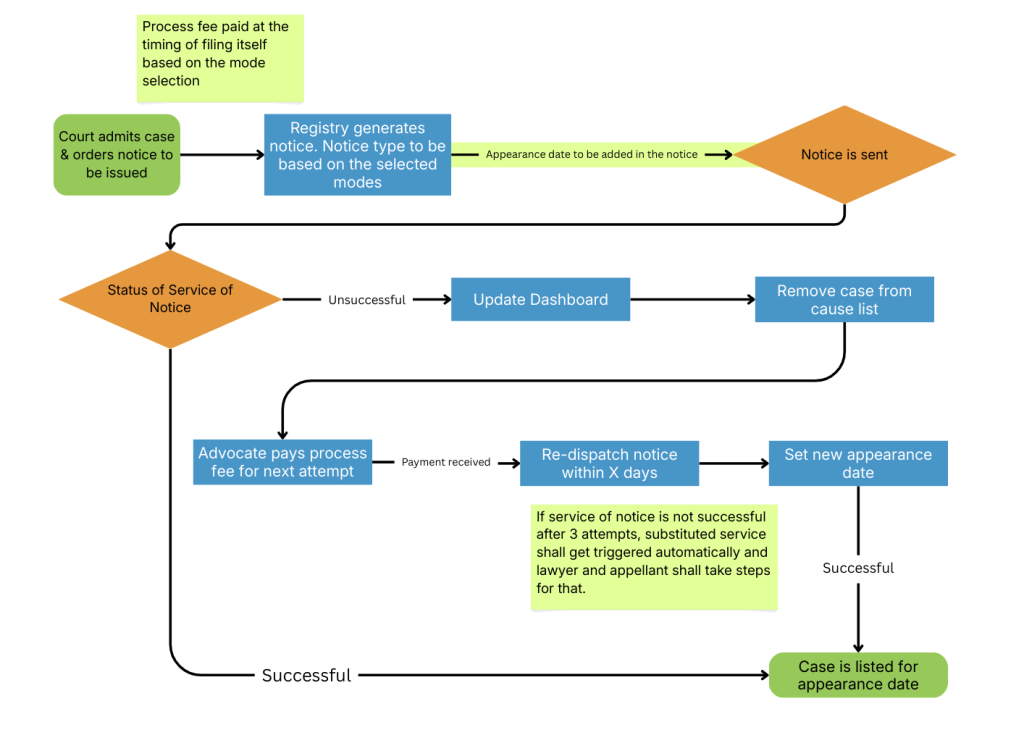
(1) Except in cases provided in Rule 55, notice shall be issued once the case has been admitted and the Court has made an order for service.
(2) When a case has been marked as urgent at the time of filing, urgency shall be assumed for service of notice as well.
(3) In the first instance, notice shall be dispatched within __ days of the order of service of notice from the Court, if the notice is to be served through Speed Post or courier.
Provided in case of emergent notice, the notice shall be dispatched on the day the Court has ordered notice.
(4) For every subsequent attempt to serve notice through Speed Post or courier, notice shall be dispatched within __ days of the process fee being paid by the Advocate.
60. Form of Notice:
(1) Once the case is admitted and an order to issue notice has been made, such notice shall be generated. Each notice shall be signed by the Registrar and shall contain the following details:
(a) The Court in which the case has been filed
(b) Names of the parties
(c) Case type
(d) Details of the case in brief
(e) The next date of hearing when the respondent has to appear in Court (f) A summary of the next steps for the respondent to follow
(g) The Court helpline number for further details
(h) Information to the respondent that if they do not appear on the day fixed in the notice, the concerned matter will be proceeded with and heard in their absence.
(2) The notice in a case issued to each of the respondents shall be accompanied by copies of the pleadings, affidavit and all annexures thereto. The process fee to be paid by the petitioner shall include printing costs as prescribed in Rule_.
(3) The notice served shall be both in English and the regional languages prescribed by the High Court.
61. Service of Notice in a Civil Case:
(1) Service of notice, including for interlocutory applications, may be done through one or more of the following modes:
(a) Speed Post;
(b) email;
(c) Courier service;
(d) Any other means of communication prescribed by the Court.
(2) The choice of the mode or modes of service shall vest with the party’s Advocate, who may, at their discretion, opt for multiple modes of service simultaneously at the time of filing of the case itself.
(3) In the initial attempt itself, the Advocate may direct that the notice be served through Speed Post or courier at multiple addresses of each respondent, if such addresses have been provided at the time of the filing of the case.
(4) In an interlocutory application in a pending case, service of notice to the Advocate in the main case shall be considered sufficient.
62. Service of Notice in a Criminal Case:
(1) Service of notice to an individual respondent in a criminal case shall be done by the police station under whose jurisdiction they reside.
(2) The Court Registry shall send an email containing the summons, pleadings, and any other documents that need to be provided to the respondent to the jurisdictional police station.
(3) The police officers shall print the required documents to serve the notice.
(4) If the respondent in a case is a company, corporation, firm or association, notice may be sent through Speed Post directly to the Director, Manager, Secretary or other officer of the company or corporation or any partner of such firm or association.
(5) In criminal cases, if the respondent is the state, service to the concerned Public Prosecutor will be deemed as service.
63. Service of Notice in a Writ Petition:
In every writ petition, as soon as the case is filed, the Standing Counsel/Advocate for the Union of India or the concerned state government shall be notified digitally.
64. Service of Notice in a Writ Appeal: When notice is directed to be issued in any writ appeal, such notice may be served on the Advocate, if any, who appeared for the respondent in the original proceedings in the High Court. In all other cases notice shall be issued to the respondent.
Provided that where any respondent remained ex-parte in the original proceedings after service of notice, the Court may dispense with the service of notice to such respondent.
64. Process of Service of Notice through Speed Post/Courier:
(1) Service through Speed Post or courier to the addresses provided by the petitioner shall be attempted a maximum of three times. If any such attempt results in the return of the notice for reasons like the address being incorrect or the party not residing in the given address, no further attempts shall be made with the same address.
(2) Real-time tracking information pertaining to the status of service through Speed Post and courier shall be made available to the Advocate on their dashboard. The Advocate may decide to change the mode of service after any attempt to serve the notice through Speed Post or courier.
(3) Delivery can be attempted multiple times before the next date of hearing provided in the notice.
(4) The reissuance of notice after each unsuccessful attempt through Speed Post and courier shall happen once the process fee for the subsequent attempt has been paid in full, unless the reason for the unsuccessful service falls under Sub-Rule (1).
(5) Where several minors are represented by a single guardian, a single process fee shall be charged for service on all such minors when service is attempted through Speed Post or courier. Where a guardian of a minor party or parties is themselves a party to the proceeding, a single process fee shall be charged for both the minor party or parties and the guardian in their personal capacity.
(6) Notice to a person with mental illnesses who has a nominated representative appointed under the Mental Health Care Act, 2017, and to a person with disability who has a guardian or a limited guardian under the Rights of Persons with Disabilities Act, 2016 must be served on the nominated representative or guardian respectively (except in Criminal Cases). Details of correspondence of the nominated representative or the guardian/limited guardian to serve notices (in the modes prescribed under Rule 66) must be provided by the Advocate of the petitioner/appellant. Where the person filing the case has reason to believe that notice is sought to be served on a person with mental illness or disability, and where no known nominated representative or guardian exists, such information must be included in the petition filed.
(7) The Advocate shall be allowed a time period of a maximum ___ to pay the process fee for the reissuance of the notice.
Provided that the Registrar may allow the Advocate more time to pay the process fee, not exceeding ___ days. If the process fee remains unpaid after a ___, the case shall be dismissed by the order of the Registrar.
(8) Substituted service shall be as per Rule 20 Order V of the Code of Civil Procedure, 1908 and shall be attempted after three unsuccessful attempts at service through Speed Post or courier.
(9) No case shall be listed before the Court for further proceedings until all three attempts at direct service and the process of substituted service have been duly completed.
65. Selection of Courier Agencies:
(1) The High Court shall form a Committee to determine which courier agencies the High Court shall empanel.
(2) The Committee shall invite applications from courier agencies for empanelment, on the terms and conditions laid down in these Rules and in their Practice Directions, as updated periodically.
(3) Every call for empanelment shall lay down the parameters of consideration for empanelment, the responsibilities of the empanelled courier agencies, and the circumstances for removal of an empanelled courier agency in detail.
66. Process of Service of Notice through Email:
(1) The petitioner shall provide the email addresses of the respondents at the time of filing, with an affidavit stating that they have used the email address to communicate with the respondent previously.
(2) For service through email, an exclusive official email address shall be created by the Court, and all emails for service under these Rules shall be sent by an officer authorised by the Court. This email address shall not be used for any other purposes.
(3) The notices and the PDF copies of email failure or “bouncing back” shall be maintained in a local virtual folder.
(4) While the emailing, following steps shall be taken by the Registry:
(a) Subject shall be mentioned as ‘Service of Court-Summons by Electronic Mail in Case No………
(b) The text of the mail shall read: Please find attached herewith Court-Summons issued by the Court of …… (Full address) in Case No…..
At the end of the email:
NOTE – This is a system generated email. Please do not reply.
If the recipient is not the intended recipient, a link may be provided to a form where they can state that they are not the intended recipient and if they have details of the intended recipient, they shall be able to provide those.
DISCLAIMER – The Court and its employees accept no responsibility for any loss, damage, claim, expense, cost or liability whatsoever (including in contract, tort, including negligence, pursuant to statute and otherwise) arising in respect of or in connection with the service of the electronic Process.
No suit, prosecution or other legal proceedings shall lie against the Court or 33
any other person exercising any powers or discharging any functions or performing any duties under or by the order of the Court, for non-delivery, insufficient or failure of service or incorrect service of electronic Process for any reason whatsoever.
(5) In appeals/revision petitions filed against interlocutory orders from a Subordinate Court, notice for both the appeal/revision petition and any related interim order shall be served concurrently. This service shall be made to the opposing party’s Advocate in the main proceeding, through email. The appeal/revision petition and the interim application shall be posted together for final disposal within __ days from the service.
(6) Service through email shall be deemed complete once the email has been sent, provided that no electronic notification indicating a failure of delivery is received by the sender within ____ days. For the purpose of further confirmation of service, the Advocate may employ an additional mode of service.
(7) Where a writ petition impugning the validity of a State Act or any provision thereof or any Rule made thereunder is admitted, notice of the petition shall be sent to the Advocate General of the state through email.
(8) If the Act, or provision thereof impugned, falls under the Union List or Concurrent List of the Seventh Schedule to the Constitution, or the rule impugned is one made by the Central Government under a Central Act, notice of the petition shall also be sent by email to the Attorney General of India.
(9) Service by email shall be considered completed 72 hours from the time of sending of the email.
(10) No case shall be listed before the Court for further proceedings until all three attempts at direct service and the process of substituted service have been duly undertaken.
67. When Process Fee is not to be paid:
(1) No process fee shall be charged for notices issued in respect of criminal appeals or references or revisions, despite being served through Speed Post/courier, except in cases of appeals or revisions against acquittal at the instance of private complainants or parties.
(2) No process fee shall be charged for notices issued in respect of references other than those mentioned in the previous Sub-Rule, where the reference is made by a Subordinate Court suo motu, and if made on the application of a party, the said party shall pay the process fee for notices issued in respect of such references.
34
68. Service of Notice in Original Side Appeal cases:
The appellant may serve the notice of appeal, intended to be served on the respondent, on the Advocate who appeared for that party in the original proceedings in the High Court out of which the appeal arises. If such Advocate accepts the notice, the party represented by them shall be deemed to have been duly served with the notice of the appeal on the date on which the notice is to be accepted. If, however, the said Advocate declines to accept the notice, the appellant shall take steps to serve the notice on the party.
69. Service to a Government Official:
(1) Notice shall be served to a government official through their official email address, as displayed on their department’s official website.
(2) The Head of the Department and the official email address of the department shall be copied in the email to the government official.
Provided that if the government official does not have an email address displayed on the official website of the department, notice shall be sent through Speed Post to the office address through the Head of the Department.
(3) Notice shall also be served through email on the appropriate Standing Counsel/Government Advocate.
70. Service of Notice in Writ Petitions:
(1) The Court may, in its discretion, at any time before a writ petition is finally disposed of, direct that notice of the petition be served on any person, whether impleaded therein as a respondent or not, who, in the opinion of the Court, may be affected by any order which the Court may make in the petition.
(2) Whenever an ex-parte interim order made in a writ petition is required or directed to be served on any person or authority not impleaded as a respondent to the petition, the copy of such an order shall be accompanied by a copy of the petition, affidavit or affidavits filed in support of it, and all the annexures thereto. It shall be the Registry’s responsibility to print all the e-filed documents for such service, provided that the process fee, including the printing costs is paid by the petitioner.
71. Service of Warrant:
In any case in which the Court orders a person to be brought either before it, or before a Commissioner, or to be removed from one custody to another, a warrant shall be prepared and signed by the Registrar and sealed with the seal of the Court. Such warrant shall be served personally upon such person. Where, however, the place of detention is not known, the warrant should be served upon the detaining authority.
14. Service of Notice to marginalised groups without permanent residence and workplace (including Migrant Workers, Pardanashin Women, Transgender People and other groups identified by the High Court): In a civil case where notice is to be served on a person from a marginalised community whose residence or workplace is difficult to ascertain, the following additional modes of service must be made asides the ones specified under Rule 66 –
1) Affixing of notice on public places close to their last known address of work or residence.
2) Publication of notice in local newspapers written in the vernacular language in the district where such person was last known to work or reside in.
Details on the methods used to verify the last known address must be ascertained and recorded digitally.
72. Summons to witnesses:
These Rules shall also apply to the service of summons to a witness or a summons for the production of documents or other material objects.
73. Notice not to be served in certain interlocutory applications:
Unless the Court orders otherwise, notice of an interlocutory application need not be given to a party who having been served with the notice in the main appeal or petition, has not entered appearance, or to a party to whom notice in the main appeal or petition has been dispensed with under the provisions of Order XLI, Rule 14 of the Code of Civil Procedure.
74. Objections/Counter Statements:
(1) Wherever the respondent in an appeal or petition has or desires to file objections/counter-statement, such objections/counter-statements shall be set forth in an affidavit by or on behalf of the respondent, and such affidavit shall be made available to the petitioner and their Advocate immediately on their respective dashboard after filing.
(2) The respondent shall also index their objections/counter-statements and file them under separate headings for ease of access.
(3) In writ petitions, the petitioner may, with the leave of the Court, file an affidavit in reply to the counter-affidavit or affidavits filed by the respondents.
-
Rule of Law ProjectRule of Law Project
-
Access to Justice SurveyAccess to Justice Survey
-
BlogBlog
-
Contact UsContact Us
-
Statistics and ReportsStatistics and Reports
© 2021 DAKSH India. All rights reserved
Powered by Oy Media Solutions
Designed by GGWP Design