
Menu
Menu

Menu

CHAPTER IV: FILING
13. Form of Memorandum of Appeals including Original Side Appeals:
Every appeal shall be preferred in the form of a memorandum signed by the appellant or their Advocate and shall contain the following particulars:
(1) the name and description of each Subordinate Court from whose proceedings the appeal arises;
(2) case number and CNR number, or any other unique identification number as provided by the information system in use by the Court, of the proceedings before each Subordinate Court;
(3) the date of the decree, order, or sentence appealed from;
(4) the names, full addresses with PIN code and Google Maps location, wherever possible, and email addresses of all respondents with their respective rank in each Subordinate Court;
(5) the provisions of law under which the appeal is preferred;
(6) concise grounds of appeal in consecutively numbered paragraphs;
(7) a list of dates in chronological order, with relevant material facts or events pertaining to each of the dates, in the form of a synopsis;
(8) an authenticated copy of judgment/decree from each court appealed from; (9) In civil appeals, the appellant shall furnish a declaration specifying:
(a) the monetary valuation of the matter in dispute as it was presented before the original court;
(b) the monetary valuation of the matter in dispute as it is presented in the current appeal before this Court; and
(c) how the valuation was arrived at by the appellant.
(10) The appellant must also provide a declaration detailing:
(a) the amount of court fees already paid on this appeal; or
(b) the amount of court fees yet to be paid on this appeal.
This declaration must also cite the provision of law under which the court fee has been calculated.
(11) In matters of appeals against criminal cases or a revision petition against conviction, except in cases where the sentence has been suspended by the Subordinate Court, the memorandum shall contain a declaration to the effect that the convicted person is in custody or has surrendered after the conviction.
(12) Where the sentence has been so suspended, the factum of such suspension and its period shall be stated in the memorandum of appeal or revision petition, as also in the application under Section 430 of the Bharatiya Nagarik Suraksha Sanhita, 2023.
Third parties may challenge orders of a Subordinate Court that affect them. They shall provide reasons for why they are challenging the order and how it affects them.
14. Enclosures with Memorandum of Appeal:
Every memorandum of appeal shall be accompanied by the enclosures required by Orders XLI, XLI-A, XLII or XLIII of the Code of Civil Procedure, or Section 423 of the Bharatiya Nagarik Suraksha Sanhita, 2023, or the provisions of any other law applicable to the appeal.
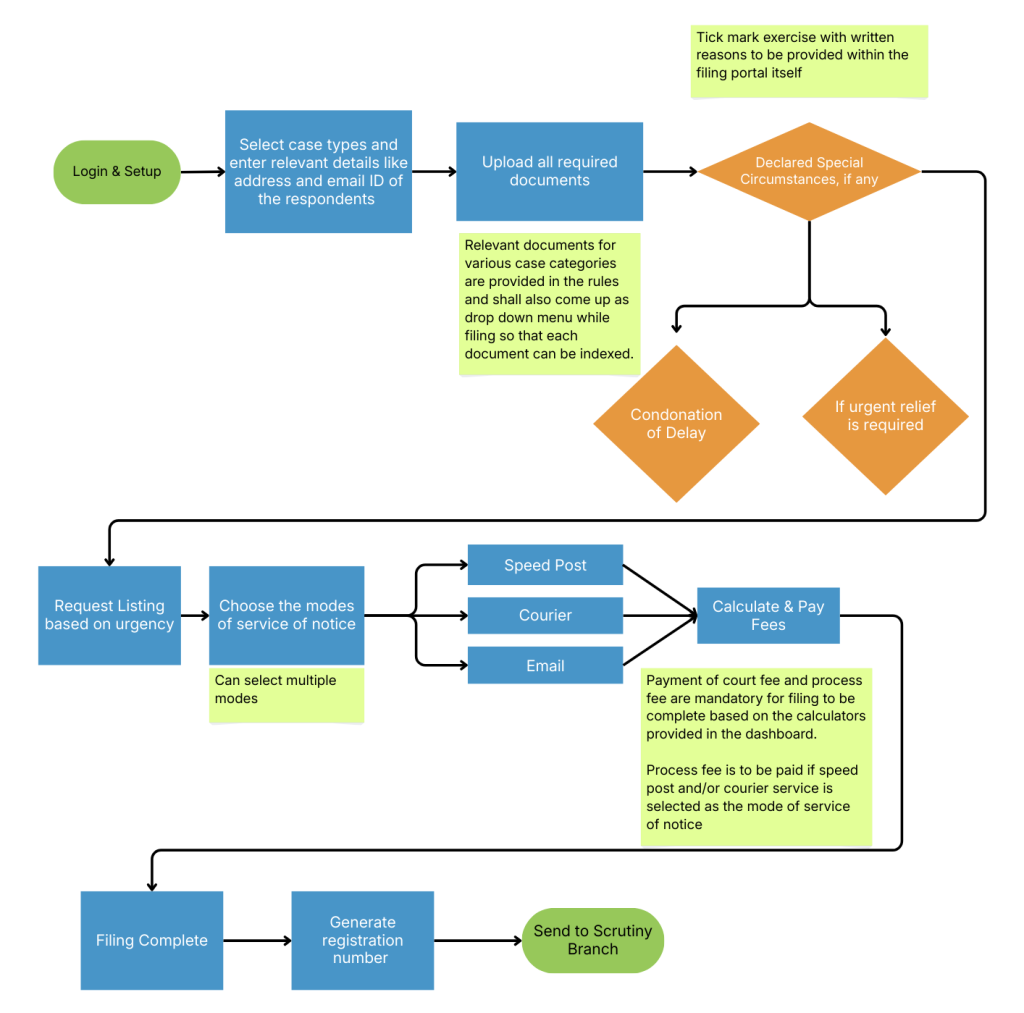
15. Condonation of Delay in Appeals:In case the appeal is being presented after the prescribed limitation period, this delay has to be disclosed at the time of filing with reasons and the grounds on which the appellant seeks to have the delay condoned.
16. Form of Memorandum of Original Petitions:
Every original petition shall be preferred in the form of a memorandum signed by the petitioner or their Advocate and shall contain the following particulars:-
(1) the names, full addresses with PIN code and Google Maps location, wherever possible, and email addresses of all respondents;
(2) petitioner’s case and grounds for relief in a narrative form;
(3) provision of law under which the petition is filed;
(4) a signed affidavit in verification or support of the petition or by way of evidence, which shall contain all facts on which the petitioner is seeking relief;
(5) the affidavit and the petition both containing the prayer in clear and precise terms;
(6) the petition verified in the manner prescribed for the verification of plaints in the Code of Civil Procedure, 1908.
17. Enclosures with Original Petitions:
(1) Every memorandum of original petition to revise any order or proceeding of a Subordinate Court shall be accompanied by
(a) A copy of the challenged order and judgment, if any, on which it is based.
(b) Where the challenged order is an appellate order, in addition to the authenticated copy of the challenged order and judgment, an authenticated copy of the original order and of the judgment, if any, on which it is based.
(c) Where the proceeding out of which the revision arises has gone through more than two Subordinate Courts, the original order of each such court.
(2) The Court may dispense with the production of any of the enclosures mentioned in Sub-Rule (1) on such terms and conditions as it may deem fit, on sufficient cause being shown upon an application made for the purpose or in its discretion.
18. Annexures to the Pleadings:
(1) All annexures to the pleadings in all cases except writ petitions shall be numbered consecutively. The consecutive numbering shall continue in all annexures produced subsequently, along with the reply, interlocutory applications or additional affidavits, etc.
(2) All annexures with the writ petition shall be marked in alphabetical order. Every annexure produced by each of the respondents and their objections to a writ petition shall be marked in the numerical order. Such numbering shall continue in respect of all additional annexures produced by that respondent subsequently, along with the interlocutory applications or additional affidavits, etc.
19. Form of Memorandum of Writ Petitions:
Every petition under Article 226 and/or Article 227 of the Constitution shall be designated as a “writ petition” and shall be preferred in the form of a memorandum signed by the petitioner or his Advocate and shall contain the following particulars:
(1) the names, full addresses with PIN code and Google Maps location, wherever possible, and email addresses for service of all the parties with their ranks;
(2) verification, if any party in the case is an establishment in the nature of proprietary concern, partnership, company, association, society, etc.
(3) all the relevant facts which have given occasion to the petition, succinctly and in chronological order;
(4) the provision of the law under which the petition is filed;
(5) the grounds for relief sought by the petitioner;
(6) the relief claimed;
(7) a signed affidavit in verification or support of the petition or by way of evidence;
Provided that when a petitioner is under restraint, and the writ petition is in the nature of a habeas corpus, the Court may, in its discretion, treat any written representation by him, sent by post or otherwise, as a petition and dispense with an affidavit.
Provided that a person detained in prison may also submit his petition through the Prison Superintendent of the concerned jail.
(8) whether there is any other remedy for such redress provided for/by any other law in force, and whether the petitioner has availed of that remedy and the result. If the petitioner has not, then they must state the reasons for such omission and the grounds on which they are invoking the jurisdiction of the Court;
(9) whether the petitioner or any person through whom they claim, had presented a writ petition on the same cause of action earlier and if so, with what result;
(10) a list of dates in chronological order, with relevant material facts or events pertaining to each of the dates, shall be furnished in the form of a synopsis;
(11) the petitioner shall state if the writ petition involves the constitutional validity of
(a) a state law;
(b) central law; or
(c) central and state law.
20. Other Particulars Required in a Writ Petition:
(1) The writ petition shall either be digitally signed or in case of a physical signature, each page of the petition needs to be signed before being scanned and uploaded.
(2) The writ petition shall be supported by an affidavit in the format provided by the High Court.
(3) The affidavit shall also set out the provision of law under which the petitioner is approaching the Court, how they are competent and entitled to make the petition and invoke the jurisdiction of the Court.
(4) If interim relief is sought, it should be through the main writ petition itself.
(5) Every petition for the issue of a writ in the nature of certiorari which seeks to quash an order of any Subordinate Court shall be accompanied by an authenticated copy of the order sought to be quashed and the judgment or enclosure, if any, containing the grounds for such an order. Where the proceedings out of which the petition arises have gone through more than one Subordinate Court, authenticated copies of orders/judgments of all the courts have to be submitted.
(6) Every petition for the issue of a writ in the nature of prohibition shall be accompanied by the original notice or proceeding, if any, served on the petitioner or an authenticated copy of the same purporting to have been issued from the Subordinate Court whose jurisdiction is questioned in the petition.
(7) Every petition for the issue of a writ of any other nature, or any order or direction, shall be accompanied by the orders or proceedings in original, authenticated copies of the same, which are either the occasion for or the subject matter of the petition.
21. Common or Joint Writ Petitions:
(1) Several persons having similar but separate and distinct interest in the subject matter of controversy involving common questions of law and facts may file a common writ petition. The court fee payable on such writ petitions shall be the same as payable on the number of writ petitions, when filed separately. For all other purposes, such as the issuance of notice, such a petition shall be treated as one writ petition. Such a common writ petition shall be in the format provided by the High Court, and shall be supported by the affidavit of any one of the petitioners. For such a common petition, one vakalat shall be sufficient.
(2) Several persons having common or joint interest but not seeking any individual relief, interim or final, may file a single writ petition.
(3) Sub-Rules (1) and (2) shall also apply to appeals against a common order. 22. Form of Memorandum of Writ Appeals:
(1) Every appeal filed from an order passed on a writ petition shall be designated as a “writ appeal”.
(2) Every writ appeal shall be preferred in the form of a memorandum which shall contain:
(a) the name and description of the parties to the appeal and their respective ranks in the original proceedings and in appeal;
(b) the address for service of the parties and that of the appellant’s Advocate;
(c) the date of the order and the case number of the writ petition out of which the appeal arises;
(d) a concise statement of the facts which gave rise to the original proceedings and result;
(e) the grounds in support of the appeal;
(f) a list of authorities upon which the appellant relies, together with a brief statement of the propositions of law for which the authorities are relied on;
(g) an authenticated copy of the order appealed from;
(h) a digital or physical signature on the last page of the pleadings by the appellant or his Advocate.
(3) The appellant seeking any interim order shall file an interlocutory application for the said purpose, supported by an affidavit.
22. Form of Statement of Reference:
Where a reference to the High Court is from a Subordinate Court seeking the opinion or directions of the High Court on any point or question, the reference shall be in the form of a statement of the case containing:
(1) the number and particulars of the suit, appeal, or other proceeding out of which the reference arises;
(2) the names, email addresses and addresses with Google Maps location (wherever possible), of all the parties interested in or likely to be affected by the reference;
(3) the facts of the case and the points or questions on which the opinion, order or direction of the High Court is sought, together with the opinion of the referring officer, court, or authority;
(4) documents which are, in the opinion of the referring officer, Court or authority, relevant for a full consideration of the reference.;
(5) Where a reference to the High Court is for confirmation of any decree, or sentence or other decision or determination by a Subordinate Court, such decree, sentence or other decision or determination sought to be confirmed, together with the entire record of the matter or proceeding in which the same has been made or passed, shall be submitted to the High Court with a memorandum citing the provision of law under or pursuant to which the reference has been made.
23. Form of Memorandum for Revision Petitions:
A revision petition for the exercise of the power conferred by Section 115 of the Code of Civil Procedure, 1908, shall set out clearly:
(1) the number and particulars of the suit, appeal, or other proceeding out of which the reference arises,
(2) how and in what manner the Subordinate Court has exercised a jurisdiction not vested in it by law; or
(3) how the Subordinate Court has failed to exercise a jurisdiction so vested, or the particular illegality or irregularity complained of, as the case may be; and
(4) if the order had been made in favour of the party applying for revision, whether it would have finally disposed of the suit or other proceeding.
24. Limitation Period for Revision Petitions when not Prescribed:
Where no period of limitation is prescribed by any other law, a revision petition shall be presented within 90 days of the order complained of. The provisions of Sections 5 and 12 of the Limitation Act, 1963, shall apply to such petitions.
25. Form of Memorandum of Cross-Objections:
The cross-objections filed under the provisions of Order XLI, Rule 22 of the Code of Civil Procedure shall be in the form of a memorandum entitled in the main appeal and shall contain the following:
(1) the names and addresses of the cross-objector;
(2) the parties against whom the memorandum is directed, with their respective ranks in the main appeal;
(3) the date on which the cross-objector was served with notice of the appeal;
(4) the objections to the decree appealed against, in consecutively numbered paragraphs; and
(5) a statement of the valuation for purposes of court fee and the amount of court fee paid or payable thereon, together with the provision of law under which it is calculated.
26. Form of Bail Applications:
(1) All bail applications shall mandatorily contain:
(a) details and copies of orders on previous bail applications;
(b) any pending bail applications before other courts;
(c) a clear indication of whether it is the first, second, or subsequent bail application; and
(d) a system-generated report of pending/decided bail applications.
(2) Investigating officers and the state counsel must ensure that the Court is apprised of previous orders in the same case.
27. Caveat:
(1) A person claiming a right to be heard in a civil or writ case, before a stay or an interim relief is granted by the Court, may at any time, file a caveat.
(2) A person intending to lodge a caveat, shall serve a notice of caveat by Speed Post due or by an approved courier service, on the person by whom the appeal/petition/application has been, or is expected to be made, furnishing following particulars regarding the judgment/order etc. in respect whereof the caveat is sought to be filed:
(a) the date of judgment/order;
(b) the name of the Court, if any;
(c) the cause title and case number, if any;
(d) government/designation of the authority, if any,
(e) particulars of the order.
The caveator may, thereafter, present the receipt of the notice of caveat at the time of filing the caveat in the court.
(3) A caveat may be filed through the website of the High Court and the person filing a caveat shall provide their following details:
(a) Full postal address;
(b) Telephone number;
(c) Email address;
(d) The type(s) of case they expect to be instituted against them.
(4) A caveat shall remain in force for a period of 90 days from the date of filing. A person who filed a caveat shall be notified about its expiration __ days before it is set to expire.
28. Dispensation of Documents:
The Court may, on application made by the parties providing reasons, dispense with the production of all or any of the documents required to be filed under these Rules, on such terms and conditions as it may deem fit.
30. General Guidelines for Filing:
(1) Every memorandum of appeal, petition or application and every affidavit and every other memorandum, or list or papers other than documents tendered in evidence, filed or presented to the High Court shall be titled “In the High Court of ___ at ____”. This shall be followed by the description of the pleading, such as memorandum of appeal, memorandum of petition, interlocutory application, as the case may be, followed by the provision of law under which it is presented or made.
(2) All the documents that are part of the pleadings, interlocutory applications and affidavits other than authenticated copies of original documents shall be typed on A4 size. The font style shall be Times New Roman, the font size of the title shall be 14 points and 12 points for the body. A 1’’ margin to be left on all sides, and line spacing shall be 1.5 points.
(3) The pleadings shall be indexed, and all the documents shall be separated and filed under different headings.
(4) The pleadings should be clear and concise.
(5) The parties or third parties shall clearly set forth their claims or averments in separate paragraphs.
(6) In case the Advocate and the party wish to physically sign the pleadings, they will only be required to do so on the last page of the pleadings and the affidavit being submitted therewith.
(7) All e-filed pleadings shall be uploaded in a searchable and machine-readable Portable Document Format (PDF).
(8) The e-filed pleadings shall not be watermarked or encrypted. These documents shall not contain any virus, malware, spam-ware or trojan horse or the like. All the e-filed pleadings shall be legible and free of all markings, track changes or annotations.
29. Process once the case is filed:
(1) Once the filing is accepted, a registration number shall be assigned and notified to the Advocate and the party.(2) In case the filing includes an audio and/or video file, the Administrator shall generate a hash value.
(3) Cases may be e-filed at any time, but for the purpose of scrutiny, any case filed after 4 pm would be considered as filed on the next day.
(4) All appeals, petitions, applications or the like in judicial matters filed during the vacation of the Court shall be considered to be filed on its first working day after vacation. Exceptions may be made in cases of urgency in accordance with the Rules from time to time made by the Chief Justice.
30. Retention of Documents:
(1) An Advocate may be asked to produce the originals of all e-filed documents by the Court.
(2) Originals of all the documents, of which authenticated copies have been e-filed, shall be preserved till the disposal of the case. The responsibility of producing the originals and proving their genuineness shall be on the party that has e-filed the copies thereof.
31. Storage and Retrieval of e-filed Documents and Pleadings:
(1) The e-filed pleading and documents shall be stored on an exclusive server maintained under the control and direction of the Court. Each such filing would be required to be separately labelled and encrypted for this purpose, to facilitate easy identification and retrieval.
(2) The Court shall ensure the security of such filings, and access to such filings shall be restricted, as prescribed in these Rules and the Practice Directions issued by the High Court.
(3) For the continuity of operations in case of a disaster, natural calamity or breakdown, a mirror image of e-filed pleadings available on the servers located in the Court will be stored at different geographical locations, as decided from time to time by the Court.
32. Filings in Court:
Except in matters filed by a person in prison or in duress or restraint or any matter made or presented to the High Court by or on behalf of any Court, Tribunal or Authority, exercising judicial or quasi-judicial functions, every matter, application or other document presented to the High Court, shall be presented either by the party themselves or by their recognised agent as defined under Order III, Rule 2 of the Code of Civil Procedure or by their Advocate or their registered clerk or by another Advocate deputed by such Advocate in the prescribed manner.
33. Appearance in a case:(1) Subject as hereinafter provided, no Advocate shall be entitled to appear and act in any civil matter before the High Court, unless they file in the Court a vakalatnama or a Memorandum of Appearance in the prescribed form, duly executed by or on behalf of the party for whom they appear.
(2) Any Advocate appearing on behalf of the Government or on behalf of any public servant sued in their official capacity shall not be required to file a vakalatnama. Such Advocate shall file before the Court a Memorandum of Appearance signed by them giving the number and cause title of the matter, name of the party for whom they will appear and the name of the person by whom they are authorised to appear.
(3) An advocate appearing for an accused person in a criminal proceeding may, instead of filing a vakalatnama, file a Memorandum of Appearance containing a declaration that they have been duly instructed to appear by/ or on behalf of the accused.
34. Memorandum of Appearance:
(1) Every Memorandum of Appearance shall consist of a declaration signed by the Advocate that they have been authorised, instructed and engaged to appear, act and plead for complainant, applicant, accused or respondent, as the case may be.
Provided, in a case where more than one Memorandum of Appearance is filed by different Advocates, the Court may require that a vakalatnama, duly executed by the accused person be filed.
(2) Where the party has personally authorised, instructed and engaged the advocate, the Memorandum of Appearance shall be countersigned by the party. Where the party is illiterate, their thumb impression shall be attested by at least two literate witnesses who shall furnish their names and addresses including police station.
(3) Where some other person has authorised, instructed and engaged the Advocate on behalf of the party, the Memorandum of Appearance shall be accompanied by a letter signed by the party, authorising such person to authorise, engage and instruct an advocate to appear, act and plead on their behalf. Such letter of authorisation shall clearly state the nature of the relationship of such person with the party.
(4) Where the party issuing the letter of authorisation is in prison, the signature of the party shall be attested by the competent prison authority. Where a request for such attestation is made by the prisoner to the jail authority, it shall be granted expeditiously.
35. Form of Vakalatnama:
(1) The form/template of the vakalatnama shall be made available by the High Court on its e-filing portal.
22
(2) Before filing the vakalatnama, the Advocate shall endorse their acceptance thereon, over their signature and enter the date of such acceptance.
(3) Every vakalatnama submitted to the Court by the Advocate shall contain their enrollment number, email address and postal address (with PIN code).
(4) The vakalatnama shall contain clearly the details regarding its acceptance by the Advocate.
(5) Where a vakalatnama is being filed by more than one Advocate, it is sufficient if the address of the senior-most among them is provided on the vakalatnama.
(6) A separate vakalatnama should be filed if the same advocate is appearing for the same party in different proceedings.
36. Robes and Costume:
Every advocate, when appearing before the Court, shall wear such robes and costume as may be prescribed by the Court.
37. Substitution of Advocate:
When an Advocate retained to appear for any party on a vakalatnama in a matter in the High Court is prevented by sickness or engagement in another court or by other reasonable cause from appearing and conducting the case of his client, they may appoint another Advocate. The Court may permit such other Advocate to appear and argue, either without filing a vakalatnama or on filing a Memorandum of Appearance.
38. Appearance in Appeal where Advocate on Record is Already Present:
An Advocate proposing to file a vakalatnama or a Memorandum of Appearance in an appeal or other proceeding in which there is already an Advocate on record, shall not do so unless they produce a written consent of the Advocate on record. When such consent is refused, they shall obtain the special permission of the Court.
39. Party-in-person:
The party that has engaged an Advocate shall not be entitled to be heard in person unless such Advocate withdraws their vakalatnama.
40. Execution of Vakalatnama:
(1) A vakalatnama shall be executed and attested by the Advocate who is accepting the vakalatnama.
Provided that if a party is unable to sign the vakalatnama in person before the Advocate, the vakalatnama shall be executed and attested by a notary where the litigant resides.
(2) When the vakalatnama is executed by a party who appears to the person before whom it is executed to be illiterate, blind or unacquainted with the language in which the vakalatnama is written, the person shall certify that the vakalatnama was read, translated and explained in his presence to the executant, that they understood it and that the executant made their signature or thumb mark in their presence.
41. Format of Interlocutory Applications:
Every interlocutory application shall
(1) set out the names of the applicants and the respondents, and their respective ranks in the main matter;
(2) the provision of law under which the application is made;
(3) the prayer or relief sought in clear and precise terms;
(4) be signed by the applicant or their Advocate who shall enter the date on which such signature is made or the application is submitted;
(5) be separately and consecutively numbered within each main proceeding.
(6) be supported by an affidavit. However, if the facts are already on record or concern the applicant’s own Advocate, the Registrar may allow a memorandum of facts signed by the Advocate instead. All facts on which the applicant relies for making the prayer or obtaining the relief sought in the application, shall be set out in the affidavit or wherever permitted in the memorandum of facts.
42. Details required in Affidavits:
(1) Every affidavit for use in the High Court shall set forth the cause title of the matter in which it is filed, and in the case of affidavits used in interlocutory applications, it shall also state the cause title of the interlocutory application.
(2) Every person making an affidavit shall be described in the affidavit, to ensure that the person is clearly identifiable.
(3) An affidavit shall be confined to statements of facts and shall not contain arguments and shall be drafted in first person.
(4) When an affidavit contains statements outside the declarant’s personal knowledge but based on the information received by them, the declarant shall:
(a) state that the statements are based on information from another source; (b) state that the declarant believes them to be true;
(c) provide the source of such information wherever possible;
(d) state the grounds for their belief, if any.
(5) The declarant of the affidavit shall either physically or electronically sign the affidavit.
Provided that if the declarant appears to be illiterate or blind or is unacquainted with the language in which the affidavit is made or written, the affidavit shall be read out and explained to them in a language known to them in the presence of the attesting officer. Such attesting officer shall certify that it was so explained in their presence and that the declarant appeared to understand it and signed their name or made their mark in the presence of the attesting officer.
(6) The attesting officer shall either physically or electronically sign the affidavit.
(7) Once the affidavit has been signed, no alterations shall be allowed and to the extent possible, the affidavit shall be e-filed in the presence of the attesting officer to ensure no tampering.
43. Attestation of Affidavits:
Affidavits intended for use in the High Court may be made before and attested by any of the following attesting officers, who are hereby empowered to administer oaths or solemn affirmations:
(1) Any Judicial Officer, Magistrate, or other Presiding Officer of a civil, criminal or revenue court:
(2) Any Registrar or Sub-Registrar of Assurances;
(3) The Registrar, Additional Registrar, Joint Registrar, Deputy Registrar or Assistant Registrar of any High Court;
(4) The Chief Ministerial Officer of any civil court by whatever name called; (5) Any notary appointed under the Notaries Act, 1952.
(6) Any other person appointed by the High Court
(7) If the person making the affidavit is not personally known to the attesting officer, they shall be identified by a person known to the attesting officer. The fact of such identification, together with the name and description of the person making the identification shall be noted at the end of the affidavit. If a person making the affidavit not known to the attesting officer, is not so identified, the left thumb impression of the person making the affidavit shall also be fixed at the end of the affidavit and be certified to be such an impression by the attesting officer.
44. Impounding an Affidavit:
(1) An attesting officer shall impound the affidavit and forward it to the Registrar for such action as they may consider necessary in accordance with law where:. (a) the declarant refutes the contents of the affidavit,
(b) the declarant is found to be impersonating,
(c) the statements made in the affidavit are ex-facie false, or
(d) the officer administering the oath or receiving solemn affirmation, considers it necessary for any other sufficient reason.
(2) Where an affidavit is impounded under this rule, the officer impounding the same shall certify thereon the date on which and the circumstances in which it was impounded.
45. Affidavits where Necessary:
(1) The High Court shall provide a list of petitions and circumstances where affidavits are required in the accompanying Practice Directions.
(2) Any document referred to in the affidavit and produced with it shall also contain the endorsement of the attesting officer in the format prescribed by the High Court.
(3) The Court may order to strike out from affidavit any averment which is scandalous, frivolous, vexatious and irrelevant or which is otherwise an abuse of the process of the Court at the cost of the offending party.
46. Classification of cases:
(4) A list of all case types that can be filed before the High Court are provided in the Practice Directions.
(5) The final decision on the creation of additional case types shall lie with the Chief Justice.
(6) Efforts should be made to classify cases in the already existing case types.
Provided if needed, any new case types shall be created according to the subject-matter of the case. The first word while classifying the case shall be based on the subject matter followed by the type of filing it is and other relevant details.
(7) Any references to case types while allocating rosters in the causelists should be consistent with the case types listed in the digital information system being used by the Court.
47. Court fee:
(1) The entire court fee payable for the case shall be paid at the time of its filing. The case shall not be listed unless the entire court fee is paid, unless there is urgent relief sought, as prescribed above in these Rules.
(2) If the Advocate wants to contest the calculated court fee, an application may be filed at the time of case filing itself with reasons for disputing the calculated court fee and the court shall decide the matter while admitting the case.
48. Automatic Generation and Issuance of Notice:
(1) Notice shall be automatically generated and sent immediately through email at the time of filing of a case where the respondents are:
(a) The union government or its departments
(b) Any state government or its departments
(c) A public sector undertakings (PSU)
(d) A local body
(e) A listed company
(2) Notice shall be considered served once the notice has been sent through email to the official email address provided by the respondents listed above and no electronic notification indicating a failure of delivery is received by the sender.
(3) Service by email shall be considered completed 72 hours from the time of sending the email. Processes described in these Rules and the Practice Directions would apply to all services by email.
49. Communication by email:
Parties can choose to receive all communication and notices through an email provided by them at the time of filing.
50. Completion of Filing:
Once the case has been filed and the court fee and the process fee are paid, the pleadings will be scrutinised.
-
Rule of Law ProjectRule of Law Project
-
Access to Justice SurveyAccess to Justice Survey
-
BlogBlog
-
Contact UsContact Us
-
Statistics and ReportsStatistics and Reports
© 2021 DAKSH India. All rights reserved
Powered by Oy Media Solutions
Designed by GGWP Design