



| |
WELCOME, THE INDIAN CITIZEN
How well is Indian democracy working? How are our elected representatives performing to make our democracy and governance work? Are we citizens, as the owners of the Republic of India, monitoring the performance of our representatives?
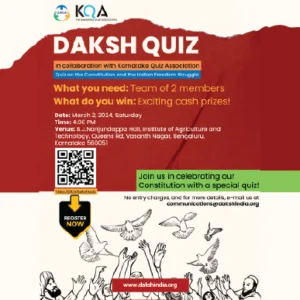
DAKSH is a movement to bring together three aspects of socio-political life:
- Politics and the people who engage in that arena,
- people's Perceptions of their elected politicians and development in their constituency, and
- Participation by people to bring about better accountability and governance.
Put these together and you can ask - and, hopefully, answer - some interesting questions: for example, does a Representative's background affect people's perceptions of him/her? Are people's perceptions of their own socio-economic well-being anywhere in line with what Governments declare, particularly through their Human Development Indicators? Does political background affect local progress? We can go on...
We don't know the answers and may never know them. But asking the questions will hopefully make our democratic system function that much better and will help bring in a measure of accountability!
Daksh's operational objectives are to:
- Track performance of elected governments and representatives by collecting relevant information on a regular basis
- Collect and present detailed, query-friendly background information about people in politics
- Elicit and present the perceptions of citizens at a local level
- Present human development indicators at the most important unit of political activity- the constituency
- Promote active citizen participation to ensure accountability in politics and governance.
Come help in improving democratic governance in India. Register and take a look at some of the data we have. Share your thoughts about Indian politics. And help grow the unique brand of democracy that India is. |
Review of KSHRC and KSCW, Apr. 2011
Accountability Initiative and Daksh
collaborated in a multi-month study of
the working of the Karnataka State Human
Rights Commission and the Karnataka
State Commission For Women. Click here
for the report.
The report was put together by Sonal
Makhija and Swagata Raha.
Daksh 2009
Review of the Karnataka Govt.
The Daksh Report includes a Qualitative
Review, Survey Data and Administrative
detail about MLAs. The Survey was
conducted in Oct-Nov. 2009 in 214
Karnataka Assembly Constituencies,
talking to 8,192 respondents of various
demographics.
Click here for the Summary Report
in English.
Click here for it in Kannada.
The Full Report is available here,
in English.
The complete survey results by
Constituency and details of MLA
Attendance and Questions Asked
is available here.
Some of the demographics data about
the 8,192 respondents is available here. |