


Designing Judicial IT Infrastructure: Towards Modular Digital Justice

I. The Big Idea: IT Backbone of the Judiciary
India’s eCourts programme has laid critical groundwork for the digital transformation of the judiciary. With infrastructure like the Case Information System (CIS), National Judicial Data Grid (NJDG), eFiling modules, and eSewa Kendras, the system has enabled digital services across thousands of courts. Yet, the next phase requires more than just digital upgrades, it demands an imagination of a modular, interoperable, and user-centric public infrastructure for justice.
The eCourts Phase 3 calls for the following technology components:
- Basic infrastructure in new and existing courts: connectivity, video-conferencing set-up, solar power back-up
- Expanding services such as eSewa Kendras and eFiling
- Scanning, Digitisation and Digital Preservation of Case Records
- Virtual and Paperless Courts
- System and Application Software Development
- Enabling systems such as cloud infrastructure, knowledge management systems and e-Office
To deliver on the vision, the entire IT infrastructure must move to a multi-layered, service-oriented architecture that supports customised, scalable, and user-aligned service delivery across the judicial ecosystem.
II. Establishing the Digital Baseline
Any meaningful IT redesign must begin with a clear understanding of the current digital landscape: what infrastructure exists, how it is used, and where users turn to external tools to fill gaps. A structured baseline assessment can inform how CIS might shift from being a self-contained system to a platform that integrates, enables, and governs a broader ecosystem. This would allow the court’s in-house teams, NIC, or identified private developers to focus on core infrastructure, secure access, and under-served use-cases, while leveraging innovation from the private sector where appropriate.
The baselining process should include:
- Mapping existing technical infrastructure (hardware, LAN/WAN, software, cybersecurity, data protection, document management licenses),
- Capturing feedback on actual usage of CIS modules and friction points across different user roles,
- Assessing readiness for API-based integrations with justice sector or legal tech platforms
Both technical audits and user-level diagnostics are essential to identify where systems are functioning, where they are not, and where new design priorities should emerge.
III. Building Blocks: What Systems Exist Today
India’s judicial IT ecosystem is currently composed of:
| Platform | Function |
|---|---|
| CIS (Case Information System) | Core database with case metadata and daily updates |
| eCourts Services App | Litigant access to case status, cause list, orders |
| National Judicial Data Grid | Aggregated dashboard for pendency and disposal data |
| eFiling/ePay modules | Filing and payment modules (varies by state) | Video Conferencing | To facilitate hybrid hearings, often using Webex or Zoom | Live streaming | To allow litigants, citizens, law students, etc to observe court proceedings remotely | eSewa Kendras | In-person digital facilitation centres |
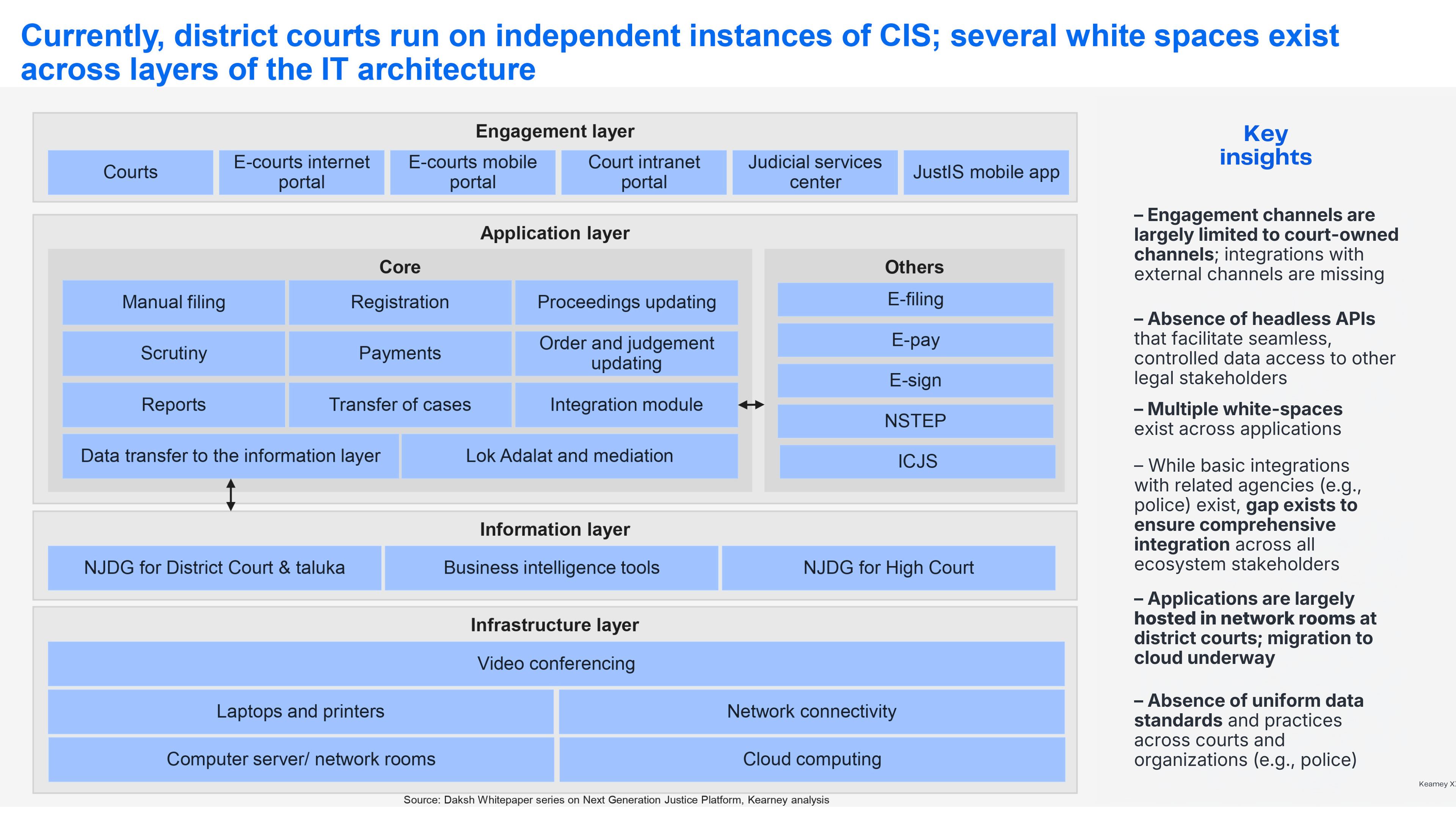
The organisation of these separate building blocks into “layers” is depicted below:
Alongside these, private tools used by lawyers for drafting, scheduling, compliance, etc., legal tech startups, and ADR providers are evolving rapidly, often in isolation from state systems.
IV. Identifying Gaps and Designing for Use-Cases
Any technical redesign must be both user and use-case driven. Some examples include:
- For litigants: Need simplified, multilingual, mobile-first access to case updates and service availability.
- For lawyers: Reliable eFiling, court calendar syncing, digital cause lists, and judgment search with intelligent filters.
- For judges: Bench dashboards that integrate pending caseload, next hearings, adjournment patterns, and drafting assistants.
- For registry: Seamless workflows for scrutiny, listing, record management, and cross-bench transfers.
- For ADR providers: Referral pipelines from courts with real-time tracking and compliance flags.
V. Principles of Modular, Sustainable IT Design
The future architecture of judicial IT should be informed by globally recognised and India-tested public digital infrastructure principles:
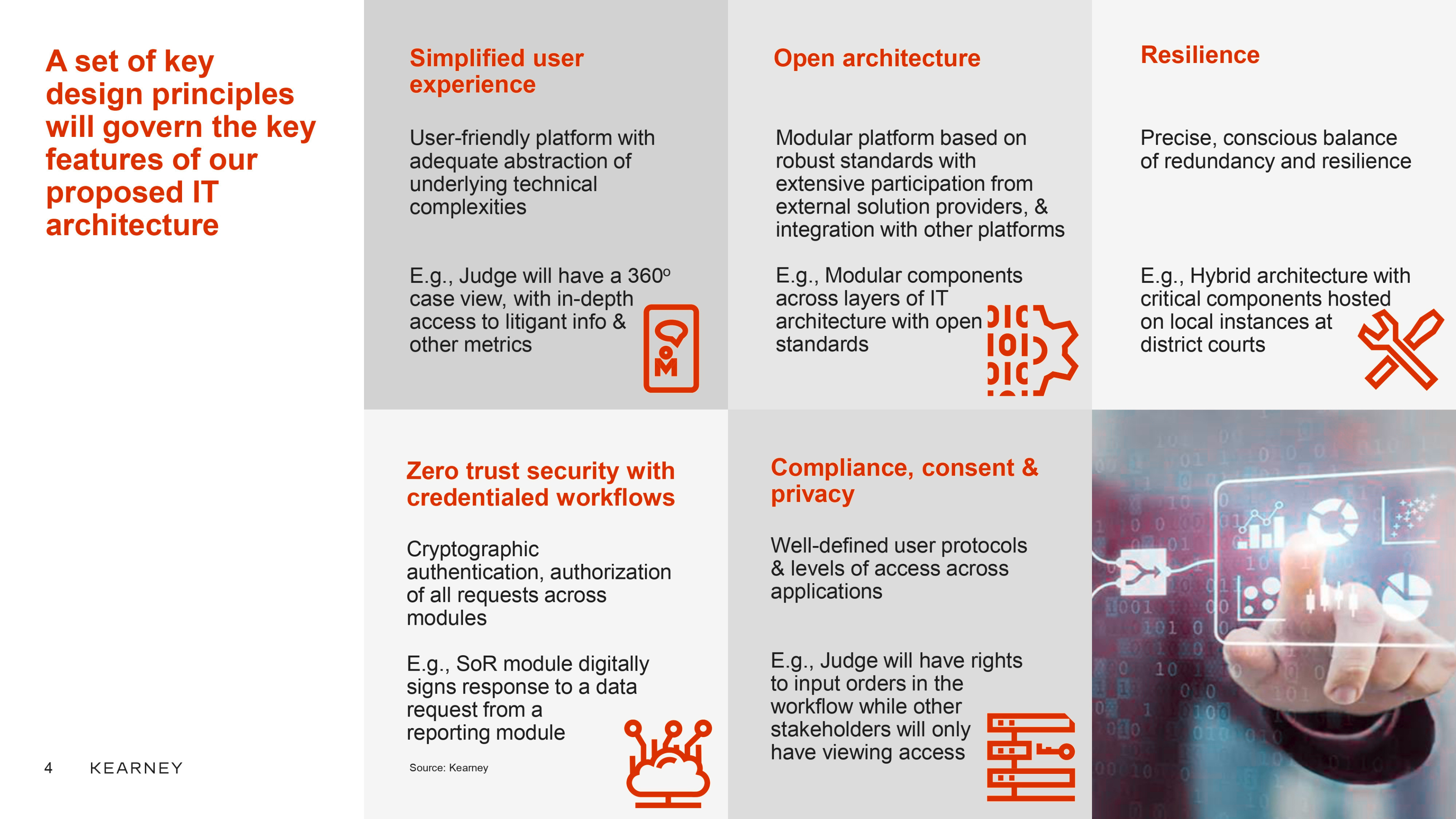
To operationalise these design principles, we propose:
Modularity: Build smaller, reusable components (ex: case number generator, digital signature validator, eNotice sender) rather than monolithic systems. These can be added, updated or replaced without compromising overall case processing.
Interoperability: Design headless APIs that can be used by other institutions (police, prisons, forensic labs, legal aid) and by certified external platforms (ADR platforms, law firms, civic tech applications).
Data Layer Separation: The system should distinguish between:
- Core metadata (e.g.: case number, type, status),
- Process data (e.g.: movement through stages),
- Content data (e.g.: pleadings, documents, orders),
- Analytics layer (e.g.: real-time dashboards, alerts, KPIs).
Privacy and Security by Design: Implement role-based access, audit trails, layered encryption, and consent-based data sharing—especially for sensitive personal or criminal data.
User-Centricity: Co-design tools with end-users. Interfaces must work on low-bandwidth connections, allow for multilingual use, be mobile-first, and accommodate disability access.
Public Standards and Documentation: Use open standards (JSON, XML), document APIs, and publish system schemas publicly so that third-party tools can integrate safely and effectively.
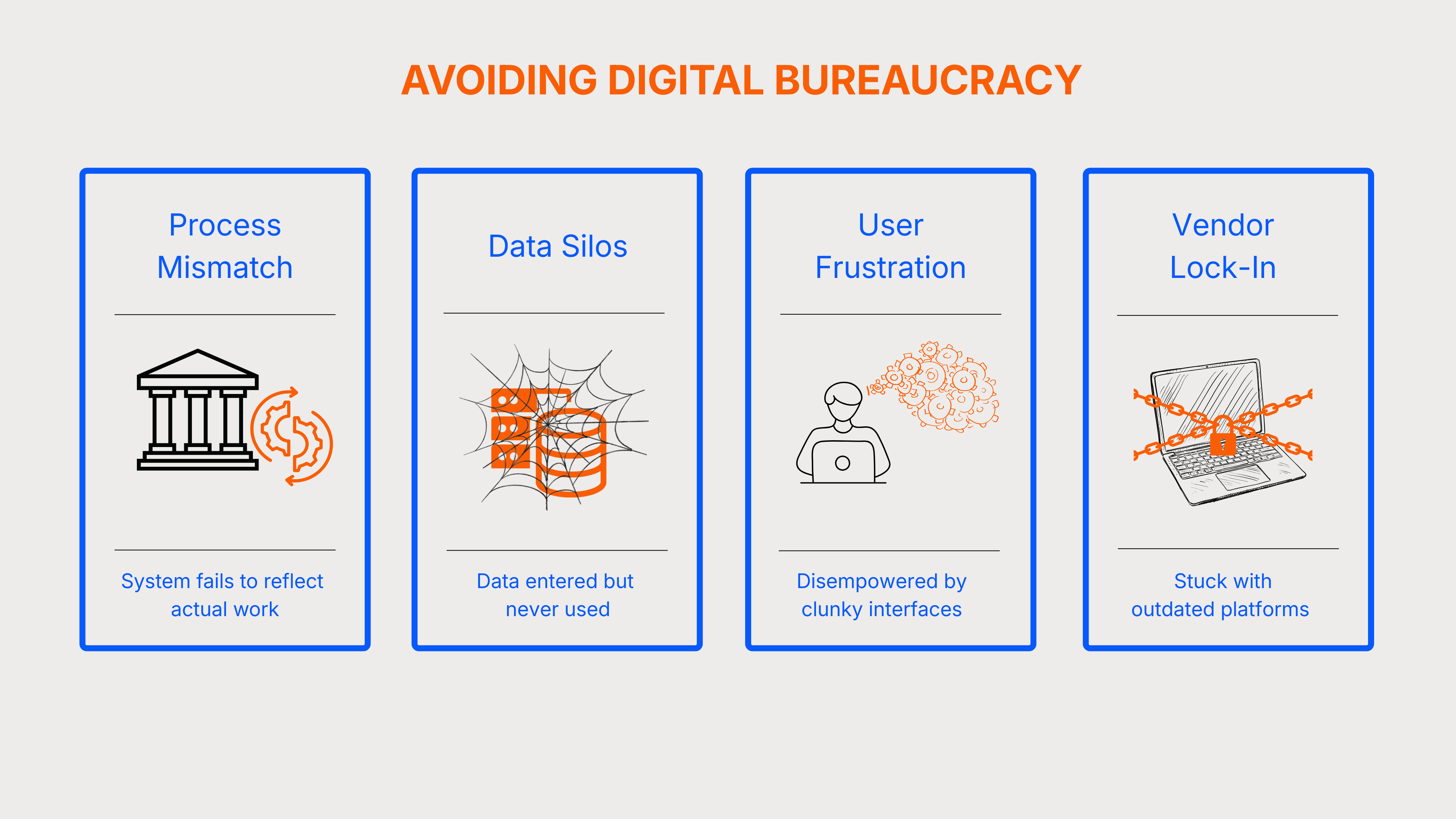
VI. Why This Matters: Avoiding “Digital Bureaucracy”
Without a comprehensive baselining and redesign strategy, digital transformation risks adding more screens and data, but also more confusion without better outcomes.
A robust IT architecture can reduce judicial delays, increase public trust, and enable innovation from legal aid startups to institutional dispute resolution. Moreover, as judicial workloads rise, only a smart, interoperable and modular infrastructure will allow courts to scale service delivery without proportionally increasing human effort.
- Systems fail to reflect actual work.
- Data is entered but never used.
- Users are disempowered by unintuitive interfaces.
- Vendor lock-in leads to stagnant, outdated platforms.
VII. Case Studies
- GST Network (GSTN): Multi-party platform enabling seamless filing, processing, and refund workflows between taxpayers, the government, and third-party platforms.
- Relevance: Judicial infrastructure can mirror this ecosystem model: plugging in private service providers and real-time validation.
- FASTag + Traffic Enforcement Stack: Integrated system across toll booths, law enforcement, and payment banks—built on open APIs and role-based data sharing.
- Relevance: Courts can integrate with traffic challan systems for enforcement and fine management.
- CoWIN and DigiLocker: Built with modularity and data privacy, allowing secure sharing and verification of certificates.
- Relevance: Digital judicial documents (ex: bail orders, summons) can follow a similar certified digital document model.
- e-Prisons and ICJS Integration: An evolving example of cross-institution data exchange among police, prisons, courts, and forensic labs.
- Relevance: The judiciary can serve as the integration anchor for justice sector platforms.
VIII. Further Resources
- National eCourts Phase III Vision Document. Supreme Court eCommittee (2022), accessible here - https://cdnbbsr.s3waas.gov.in/s388ef51f0bf911e452e8dbb1d807a81ab/uploads/2023/04/2023042088.pdf
- IndEA Framework (India Enterprise Architecture Framework). Ministry of Electronics and Information Technology Government of India (2018), accessible here - https://egovstandards.gov.in/sites/default/files/2021-10/IndEA%20Framework%20V%201.0.pdf
- Next Generation Justice Platform. DAKSH 2019, accessible here - https://www.dakshindia.org/next-generation-justice-platform/
- GovStack Definitions: Understanding the Relationship between Digital Public Infrastructure, Building Blocks & Digital Public Goods. Digital Public Goods Alliance (2022), accessible here - https://www.digitalpublicgoods.net/DPI-DPG-BB-Definitions.pdf
- The Governance of Digital Public Infrastructure. Aapti Institute 2024, accessible here - https://aapti.in/wp-content/uploads/2024/06/AaptixONI-DPIGovernancePlaybook_compressed.pdf