CHAPTER 20
Shailaja Shukla and Supriya Sharma
“ Thinking is the capital, Enterprise is the way, Hard Work is the solution.”
◆ Globally, legal tech is a fast-growing sector. However, the worldwide pat- terns of growth and expansion of legal tech may not carry over to India;
◆ Sparse digitisation of records and processes is the biggest challenge for startups building solutions for the judiciary;
◆ Legal tech startups in India are creating solutions in four major groups—legal service delivery, process efficiency, access to justice and DIY tools;
◆ The private sector in India has undertaken incubation and support pro- grammes for legal tech startups;
◆ A decisive step towards enhancing career options for graduating lawyers is an early introduction to entrepreneurship.
As of 11 July 2023, there were over 50 million pending cases across the Supreme Court, 25 high courts and over 650 district and taluka courts encompassing about 3,400 court complexes in India. 1,2,3 Considering the pendency, litigants in India spend about INR 300 billion in litigation costs 4 – roughly 0.3 per cent of India’s GDP. There is an additional litigants’ productivity loss of about INR 50,000 which adds up to about 0.48 percent of the GDP.
While this gives a sense of the size of the market, the estimates do not include the legal services that are developed and delivered by law firms, and corporate and independent lawyers in the country. Law firms particularly have been known to struggle with operational inefficiencies over their evolution. 5 Such inefficiencies across the value chain create an opportune ground for tech-enabled interventions. The mainstreaming of startups and proof of use cases of novel technologies like blockchain and machine learning in adjacent sectors will create a launchpad for disruptive, tech-driven solutions in India.
In comparison to more evolved legal ecosystems such as the US, India pres- ents a curious case where the legal systems have a rich history, the judicial and legal systems 6 continue to be complex, and the economy is fast digitising. There are several barriers to realising the legal tech opportunity. Sparse digitisation of records and processes is the biggest challenge for the judiciary. There has been some resistance from lawyers about being replaced by machines. Alarie, Cockfield and GPT-3 make a rather ironic point with their paper, authored entirely by the bot GPT-3, on how machines will never replace humans. 7 Finally, the curriculum of over 1,500 Indian law schools is disconnected from market realities, 8 making law graduates difficult to employ. In such a context, we examine the current legal tech startup ecosystem to lay down suggestions on how founders and other par- ticipants can overcome these barriers.
We begin with diving into the multiple descriptions of legal tech and related terms like law tech to suggest a customer-centric definition. Next, we briefly touch upon the US and UK legal tech startup ecosystems and then present a landscape of the Indian ecosystem on six themes. These include history, funding, locations, founders, business models, and legal tech on incubation initiatives. Under each theme, we present key insights based on our analyses of over 330 legal tech start- ups in India that we enlisted by the end of 2021 and share our outlook on the future and/or next steps under respective sub-sections. We close the chapter with our submissions on three promising opportunity areas for startups, incubators and investors.
In literature, the term ‘legal tech’ emerged only as recently as 2017. 9 The neolo- gism was originally coined to denote technology used by legal professionals 10 to assist their services as well as the delivery of justice. Parallel narratives also raised questions about legal tech replacing lawyers. 11 Other terms related to law, such as ‘reg tech’ 12 – technology for regulatory compliance – soon followed. On similar lines, legal tech is often defined as ‘all technology used by law firms to improve their processes and increase their efficiency and effectiveness’. 13 This definition, supported by many from the industry, is narrow in that it only talks about one of the stakeholders of the legal system. A more comprehensive definition takes into consideration the clients and citizens to define legal tech as ‘digital tools, software and technology to improve the services provided by the legal industry’. 14
Much like academia, the industry is populated with definitions of segments such as law tech and even justice tech. While the former is about empowering individuals and small businesses by creating solutions such as Do-It-Yourself (DIY) products or legal services aided by technology, 15 the latter focuses on tech- nology solutions to ‘directly scale legal services to the billions of people under- served by the existing markets’. 1 6 A narrow approach to defining the scope of a sector or industry can come in the way of establishing legitimacy, especially over overlapping boundaries, and competition for attention and resources. This is truer for start-ups and new ventures that are already known to struggle with liabilities of newness and smallness. 17 These definitions often take only a supply-side per- spective. Seen from the eyes of a legal professional, it may be natural to distinguish back-end services – legal tech – from front-end ones – law tech. However, when one situates the customer, primarily citizens, businesses, and judiciary, as the central point of reference, legal tech is essentially the overlap of legal services and technology. Depending on the customer’s persona, legal services could include, but not be limited to, developing and executing agreements, regulatory compli- ance, accessing legal advice, or background case research. A wide spectrum of technology could be applied to design, improve, and/or deliver these and many more processes and services related to law.
Thus, taking a comprehensive, as against an exclusionary, customer-focused view, we consider legal tech to be technologies ‘that enable and improve access and usage of legal services, including access to justice as well as development and delivery of these solutions by legal service providers’.
In its short history, legal tech has made its presence felt in leading startup eco- systems. Across all metrics, legal tech is a rapidly growing sector, having seen a staggering 484 per cent rise in the number of legal technology patents since 2017. 18 There are over 6,700 legal tech companies in the world 19 with the US, the UK and China being some of the largest legal tech markets. Most of these markets are distinct in their history and growth trajectory.
The US has by far the largest and fastest-growing legal tech market. Some of the biggest names in the legal tech sector globally – LegalZoom, Clio, LexisNexis – were founded in the US. At least 13 of the 23 startups that have made it to the Initial Public Offering (IPO) stage were based in the US. 20 The legal tech market in the US witnessed steep growth in the last decade, going from about 15 startups in 2009 to over 1,400 by the end of December 2020 – a compounded annual growth of over 50 per cent. 21 Much of this growth could be attributed to the underlying legal services market. The US legal services market was valued at about USD 350 billion and is estimated to account for about half of the global legal services market. 22 In terms of investment, the US legal tech market has been drawing private capital since 2008, reaching a record high of USD 1.5 billion in investments in 2021. 23 At the end of 2021, there were about eight unicorns in the US, 24 the latest being Everlaw, a cloud-based e-discovery software, valued at USD 2 billion. 25 In addition to private equity investments, IPOs and mergers and acquisitions (M&As) are also becoming mainstream in the US legal tech startup ecosystem. 26
Another active legal tech ecosystem is that of the UK. With over 500 startups, the UK legal tech market or Lawtech, as it is locally referred to, is pegged at about USD 29 billion. While the UK market may be smaller compared to the US, a unique feature of the UK legal tech market is the participation of large consulting firms. Global giants such as Deloitte and PwC have established legal tech incubators in the region. Deloitte announced Deloitte Legal Ventures in 2019 to provide a variety of inputs including access to consulting, technology, and legal and investment experts, to a cohort of 14 companies. 27 PwC’s legal arm also launched a programme in London to support legal tech startups in 2019. The 10-week Scale | Law Tech programme. 28 was designed to allow startups to go through specific masterclasses and pitch to a network of industry leaders to obtain commercial support.
Against this global backdrop, we now turn our focus on the fast-growing legal tech ecosystem in India. Taking startups to be the harbingers of innovation, we scope our analysis on legal tech startups. We map the current contours of the ecosystem and highlight emerging opportunities and future pathways.
Creating a list of legal tech startups in India was the first step in the landscaping exercise. Over several months, we mined startup databases, undertook extensive internet searches and expanded our list of startups by seeking references from our network of founders and participants in the legal tech ecosystem. We paid atten- tion to excluding law firms and incumbents from our list and used our definition, from above, to identify legal tech startups. By the end of 2021, we were able to add 336 entries to our database of legal tech startups in India. 29
Next, we undertook a thorough secondary information search on these start- ups and conducted interviews with over 20 founders and other value chain participants in the legal tech ecosystem. These interviews were predominantly aimed at validating our analysis of the current landscape and outlook on the future. We recorded all interview calls after taking informed consent from par- ticipants. We also made extensive notes during the interviews which were used in the analysis.
In the following subsections, we describe the six aspects of the current landscape of legal tech startups in India – growth, investment trends, spatial spread or location, founder profiles, business models, and start-up incubation initiatives.
While the term legal tech caught on in the late 2010s, we find that some of the first legal tech startups in India were founded in the early 2000s. These included companies like PracticeLeague, a law management firm, and Ezzus, an incorpo- ration and compliance firm. From four companies in 2000 to 54 new companies founded in 2020 alone, legal tech startups have grown at an average YoY growth rate of about 30 per cent, with two peaks in 2015-2016 and 2020 (see Figure 1 for growth in legal tech startups).
We posit that the first peak (2015-2016) may be attributed to the launch of the Startup India initiative, which sparked startup activity across industries, sectors and problem statements. The second and slightly higher peak (2020) appears to be influenced by the growth in the legal tech market globally but was amplified by the COVID-19-induced adoption of digital technology by businesses.
Subject to some caveats, we envisage that the growth rate of legal tech start- ups is likely to become steeper due to multiple reasons. These would predom- inantly include the digitisation of business and judicial processes, which were activated by the pandemic, and the launching of initiatives like NITI Aayog’s ODR Policy Plan. 30 The third reason is proof of concept of technology like Artificial Intelligence/Machine Learning and Blockchain technology in adjacent sectors like fintech. 31 Training law graduates in entrepreneurial thinking and channelling more incubation support for early-stage startups would not only catalyse the founding of legal tech startups but also contribute to their survival and growth.

Figure 1: Growth of legal tech startups
Source: Authors’ Analysis
Startups in our database received external funding only in the last seven years, between 2014 and 2021 (see Figure 2 for funding raised by legal tech startups). At least 23 startups raised investments of over USD 27 million in 50 funding rounds in early stages – mainly, angel, pre-seed and seed rounds. For perspective, these investment numbers must be seen in comparison to numbers from more prolific startup sectors in India like fintech where over USD 28 billion (about 1000 times that of legal tech) were invested in about 2500 rounds (about 50 times that of legal tech) during the same 2014-2021 time period. 32
About 10 per cent of the funding (about USD 2 million) was in angel invest- ments. However, we were not able to find any data on grants received by any of the 336 legal tech startups in our database. We see this as a sign of a thin legal tech incubation ecosystem and limited participation from regional and central government agencies – the main sources of grant capital for startups.
Expectedly for this nascent sector, legal tech startups have largely raised seed-stage funding, except between 2020-2021, where we see legal tech startups raising series-A and pre-series-A rounds. While there have not been exceptional exits for investors thus far, there have been several cross-border acquisitions. Table 1 below presents some recent, notable investments and acquisitions in legal tech startups.
In cognisance with a growing domestic and international market, and support interventions from governmental agencies, we posit that more funding in early and growth stages will be available to legal tech startups. However, we expect the growth stage funding will be channelised towards incorporation and compliance products, dispute resolution and law firm operations, as against products for the judiciary (which still requires a defensible proof of concept).

Figure 2: Funding raised by legal tech startups 2014-2021
Source: Authors’ Analysis
Table 1: Notable investments in acquisitions in legal tech startups
|
|
Time |
Details |
|
Investments |
December 2021 |
Jupitice, ODR focused startup, raised $4M in a Pre-Series A round led by Almas Capital Ltd. 33 |
|
January 2022 |
LegalKart, a marketplace, raised $537K in a Pre-Series A round from Mumbai Angels and the Indian Institute of Management (IIM) Udaipur Incubation Centre 34 |
|
|
February 2022 |
Presolv360, also an ODR startup, raised $1M in Seed Funding from MGA Ventures, Omidyar Network India and other individual and institutional angels 35 |
|
|
Acquisitions |
February 2016 |
Singapore’s Lawr.co acqui-hired LawFarm, a service provider marketplace 36 |
|
May 2016 |
MyeCA acquired Lawin1, an incorporation management startup, at $584K 37 |
|
|
February 2022 |
Lawyered acquired the compliance management startup Let’s Scale Up 38 |
In landscaping legal tech startups, we paid attention to their location or spatial spread to primarily comment on the future hubs of legal tech in India (see Figure 3 for the geographic spread of legal tech startups). The location of startups may also suggest proximity to their markets/customers whose problems the startups are trying to solve. For instance, a large number of startups founded over the last 20 years are located in the National Capital Territory (NCT), which could be influenced by the proximity to the Supreme Court of India and the socio-political climate of the region.
In addition to the NCT, states such as Maharashtra and Karnataka with pro- lific business ecosystems, host a large number of legal tech startups. None of the startups in our database were founded in the northeastern states, and very few are from central India, including states such as Chhattisgarh and Madhya Pradesh. We also examined the location of startups in contrast with the presence of the 23 National Law Universities. We see no correlation between the two. Several leading voices in the legal profession have urged Indian legal education to be reoriented towards market realities. 39 We believe that building micro-entrepre- neurship ecosystems in and around leading law universities would not only help open entrepreneurship as a career option for graduates but also impart skills that enhance their employability.

Figure 3: Geographic spread of legal tech startups
Source: Authors’ Analysis
To be able to understand the motivations underlying the founding of legal tech startups, we delved into an analysis of the founders’ profiles from our dataset. Towards this, we randomly selected 122 startups – about a third of our sample – to get insights into the background of the founders building legal tech startups. We segmented the background of the founders into three categories:
(i) Legal: Founders with an academic background in law and compliance
(ii) Technology: Founders with education and/or experience in technology
(iii) Others: Founders with non-legal, non-tech background. We applied this segmentation to 183 founders across the 122 startups.
Two key patterns emerged. One, the predominance of solo entrepreneurs and two, the presence of founders with no legal or technology backgrounds. When we look at the combination of co-founders in our data we find that of the 122 startups, 75 (about 61 per cent) have been founded by solo entrepreneurs. There is a com- mon belief in the industry, especially the investing business, that founding pairs and teams are better than solo founders. 40 While evidence to the contrary may be starting to appear, 41 founders in an emerging sector (legal tech) in a fast-growing ecosystem like India may be subject to evaluation on common and perhaps safe metrics such as the need for co-founders, as against solo founders. Thus, solo legal tech founders may consider recruiting co-founders so that investors can assess them favourably, and also build a varied capacity pool. This includes technology, market, operations, and marketing among others, often required in a growing startup.

Figure 4: Breakdown of backgrounds of legal tech startup founders
Source: Authors’ Analysis
While almost half the founders, around 45.9 per cent, have a legal background and may obviously be attracted to the legal tech sector, it was interesting to find that over 25 per cent of founders, in 61 startups, come from non-legal, non-tech- nology backgrounds (see Figure 4 for a breakdown of founders’ backgrounds). This merits further analysis to ascertain the motivations of these founders, so that adequate support systems may be designed for them.
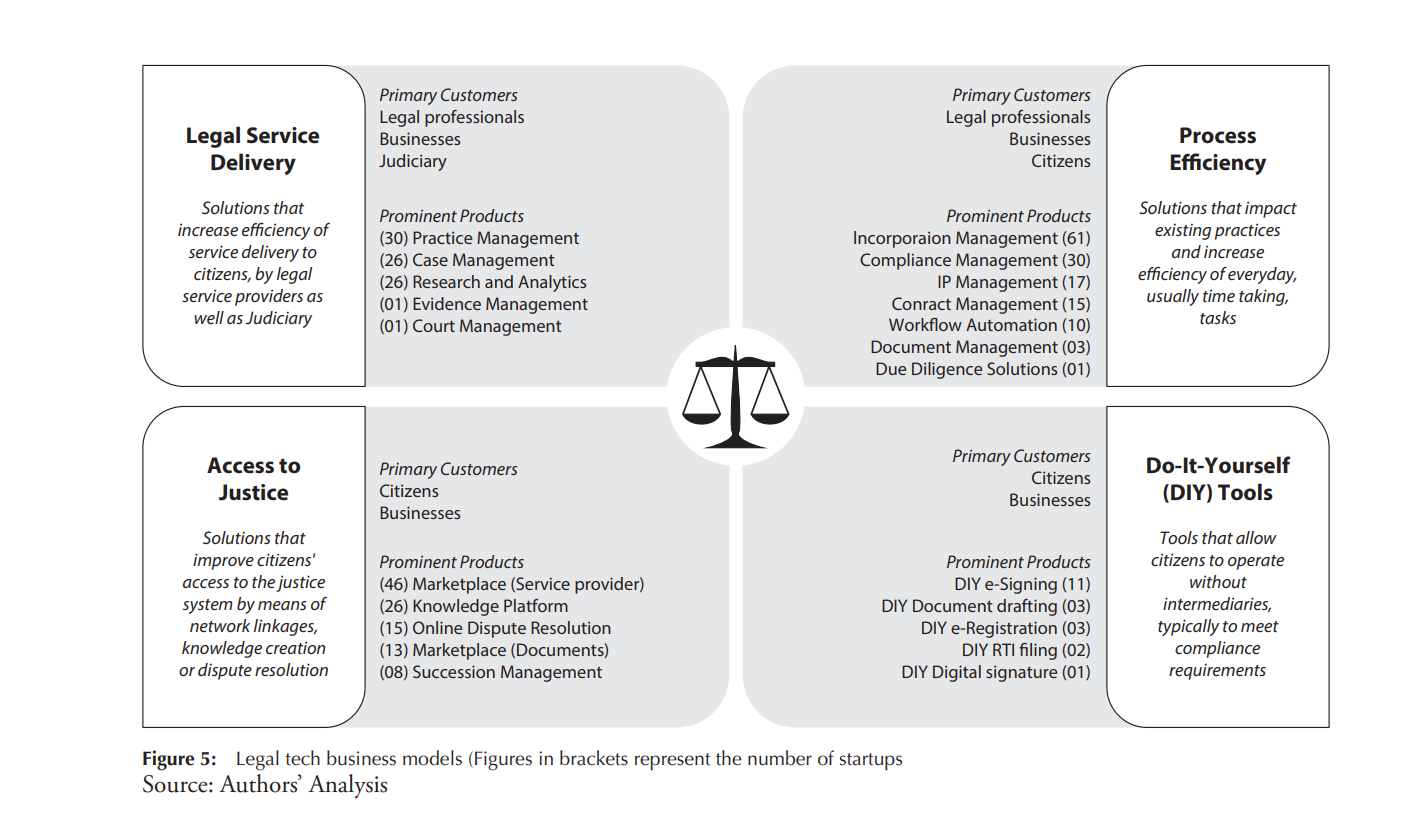
We find that Indian legal tech startups are adopting a variety of business mod- els and solving a range of problems in the legal services value chain. Taking a problem-centric view, we categorised legal tech startups into four major groups — legal service delivery, process efficiency, access to justice, and DIY tools, with sub-categories therein (see Figure 5 for legal tech business models).
We find most startups build legal services or document marketplaces like Legalkart, Legal Docs, LawRato, or case management and research solutions for lawyers like Legistify, CubicTree, mLeAP. Products in incorporation man- agement include IndiaFilings, LegalRaasta, Company360, while practice man- agement solutions for legal professionals include ProVakil, DigitPrac, THEO. E-signing products include Leegality, SignEasy, and LunarPen among others. In the absence of a validated proof of concept, evolving product market fit, and unclear regulatory framework, we find fewer startups building products for categories that include but are not limited to, succession management and court management.
Of all the business models comprising the legal tech startup landscape, seven business models, in particular, present a significant opportunity for new startups, incubators and investors. These include practice management, case management, research and analytics, contract management, online dispute resolution, incor- poration management and digital e-signing. We will elaborate on each of these models taking up an illustrative case of a representative startup.
Practice management
Senior lawyers in law firms (particularly those in managerial roles) lose consid- erable time on administrative tasks. These include HR and payroll-related tasks, invoicing and accounting, client database management, to name a few. Practice Management solutions offer customised Enterprise Resource Planning (ERP) solutions that streamline administrative tasks and facilitate efficient utilisation of executive time. These solutions are often built on top of a case management dash- board, providing legal service providers with an all-in-one platform to manage both legal and operational aspects of their practice.
Case study - ProVakil: 42 Founded in 2015, ProVakil offers a cloud-based practice management software for law firms as one of its proprietary products. Its primary features include:
1. Case management: A collaborative interface for matter, document and task management along with calendar integration and real-time case updates
2. Client management: Facilitates client intake, conflict check and limited access to clients allowing collaboration
3. Billing automation: Includes expense management, time-sheet interface and integration with accounting systems to establish a process flow
4. Reporting and insights: Provides key metrics such as cost management and revenue forecasts to optimise operations.
In its six years of operations, ProVakil has become one of the most prominent names in practice management in India serving 10,000+ legal professionals across organisations, law firms and individual lawyers.
Case management
While case management is part of the larger umbrella of practice management, its centrality in legal services merits a separate mention. Several legal tech startups, for instance, only offer case management products. Legal professionals have to keep track of multiple touch points with the judiciary and clients throughout the journey of each case. Most professionals often deal with multiple cases spread across long timelines for various reasons including delays in the judicial process.
Case management software allows legal professionals to track cases and case minutiae, provides preparation tools in terms of research and taking notes, and sends automatic updates to clients about case progress. Among other attributes, it also creates a calendar-based dashboard to track important dates. While large law firms often onboard legacy software firms to build customised solutions through Software as a Service (SaaS) offerings, startups can bring some level of standardisation and also improve engagement between law firms. They have a higher potential to build an interface with the client, reducing the litigant’s sole dependency on lawyers for receiving updates.
Case study - CaseDocker: 43 This startup was founded in 2013 by two founders with strong technology and product management experience. It has four core modules – case management, virtual legal workplace, communication and collab- oration, and virtual assistant. Their case management system covers three primary features.
The ‘Client Manager’ provides a real-time interface to the client allowing faster communication, easier information sharing and efficient administration. The ‘Client Case Manager’ is a service provider side dashboard that presents a holistic view of the details attached to a case such as relevant documents, associ- ated litigants, advocates and judiciary, and case notes and task lists. The ‘Court Notifications and Updates’ feature largely imparts legal service providers with updates on cases and the daily cause lists from courts.
Research and analytics
Lawyers spend about a third of their time, roughly 15 hours a week, on legal research. 44 While online databases have existed for some time now, the actual research and analysis process remains largely manual, leaving scope for human error/omission due to the volume of data that needs to be analysed. Artificial Intelligence or A-based analytical tools, aided by Machine Learning (ML) and Natural Language Processing (NLP), applied to past case data including decisions and case proceedings enable legal professionals with comprehensive research, thus enhancing the quality of service to their clients.
Several versions of research and analysis tools are also available to end con- sumers. The products gather and present volumes of data in a condensed and consumable format to empower the consumers as beneficiaries of the legal system.
Case study - LegitQuest: 45 Founded in 2017, LegitQuest has developed an AI/ ML-powered search engine that allows constant improvements to refine search results. It allows users to search through additional sources such as tribunals, acts, articles and other secondary material, apart from the judgements of the Supreme Court and high courts of India. It also presents select information in visual form to make the search more effective and accessible. Its ‘iDRAF’ feature allows users to navigate through issues in a case, facts, arguments, reasoning, and decision, in a structured manner, thus reducing the time spent in analysing a judgement. According to LegitQuest, the platform is designed for use by a variety of consumers including attorneys, law firms, state judicial officers, law students, corporates, governments, consultants, and litigants, among others. By the end of 2021, the startup had raised over USD 1 million in funding and was registering over 2,00,000 monthly users.
Contract management
One of the major functions of a corporate legal professional is to draft and review contracts. Given the variety in terms, this exercise of drafting and vetting contracts could require significant customisation and can be time-consuming. Contracts, once enforced, may also need regular hygiene checks. Contract management tools automate the creation and execution of contracts, allow collaboration while draft- ing, and automate the management of enforced contracts. They save time and resources for legal service providers, customers and businesses in general. Contract management products also pave the way for smart contracts that make arbitration more effective. 46
Case study - SpotDraft: 47 This startup offers a contract lifecycle management tool for legal and business teams to automate contract flows collaboratively. Starting from custom templates, it allows users to create, edit and generate contracts. Its collaborative feature automatically updates any changes made throughout the document. It also has an e-signature feature that enables teams to execute doc- uments rapidly, and an audit trail that keeps a record of the entire process. Its built-in intelligence performs error checks such as repeated terms and mismatched definitions and also makes contracts search-enabled. A dashboard allows the user a centralised view of all ongoing contracts across teams and departments.
SpotDraft was founded in 2017 by founders with both legal and technology expertise. It has a team of about 80 people and has processed over 1,00,000 con- tracts. By the end of 2021, SpotDraft had raised about USD 4 million in seed funding.
Online dispute resolution (ODR)
The combination of electronic communication technologies and methods of Alternate Dispute Resolution (ADR), such as negotiation, mediation and arbi- tration, represent ODR as a product category. 48 With confidence in the e-courts system on the rise, both ODR as a concept and ODR products, have seen over- whelming support from the Indian judiciary. 49 NITI Aayog’s expert committee report on ODR also showcases the government’s inclination towards supporting ODR initiatives. 50 Typically, the process of ODR begins with the registration of the dispute by one of the parties involved. Subsequently, the other party/parties is/are invited to register on the said platform. The platform provider then ensures timely resolution through their mediation or arbitration experts.
There are several micro and system-level benefits of ODR. At the individual level, ODR can save time and cost for litigants. 51 At the systemic level, ODR products demonstrate the promise of easing the burden on the judicial system. As more and more companies adopt ODR, the room for further innovation in this space keeps expanding. 52
Case study - Presolv360: 53 Founded in 2017, Presolv360 has been recognised by the Ministry of Law and Justice, Government of India, for its efforts to resolve disputes quickly and in a cost-effective manner. The startup offers end-to-end online resolution of disputes through proprietary arbitration and mediation mod- ules. PreSolv360 is supported by some of the leading incubators in the country, such as SINE Business Incubator (IIT Bombay) and NSRCEL (IIM Bangalore), which is evidence of industry confidence in ODR. The startup has raised over USD 1 million in funding and was incubated by Prarambh, India’s leading legal tech incubator.
Incorporation management
According to the Ministry of Micro, Small and Medium Enterprises (MSME), there are over 63 million MSMEs in India. 54 This indicates the scale of the market for business incorporation and compliance management. Until very recently, legal processes involved in incorporation could dampen the spirit of any entrepreneur. Compliance requirements are getting easier, leading to improvements in Ease of Doing Business rankings for India. 55 Also, the market for end-to-end assistance in IP registration, typically for technology startups, compliance and incorporation, for legal tech startups, is large.
Case study - Companify: 56 Founded in 2020, Companify is a tech platform that provides legal and compliance services associated with the registration of businesses in Delhi. These services include company registration (startup, MSME, section-8) intellectual property registration, GST registration and filing, compliance plan, change in or closure of business and other required certifications, such as ISO. Companify operates through an in-house team of chartered accountants (CA), company secretaries (CS) and certified manage- ment accountants (CMA) who interact with customers through the Companify website or mobile application.
DIY e-Signing
Businesses lose significant resources and time while dealing with documentation. These costs could rise proportionately with the volume of operations of a busi- ness. In the last two decades, most large and many small businesses globally have moved to digital documentation. The COVID-19 pandemic has also accelerated the regulatory adoption of digital documents. In 2020, the global digital signature market was sized at USD 2.8 billion. E-signing solutions allow businesses and individuals to digitally sign documents in a secure and legally compliant manner. In the financial services sector, e-signing solutions save up to 90 percent costs compared to paper-based documentation. 57
Case study - Lex-sign: 58 Founded in 2020 by founders with a collective legal experience of over 15 years, Lex-sign is a technology platform that allows users to e-sign and executes documents virtually. It offers additional secure verification in multiple ways including One Time Password (OTP) verification, digital sig- natures and Aadhaar-based signatures. It has different offerings for startups and larger enterprises customised to their needs.
Apart from marketplace-based models and business models akin to the ones enumerated above, we see nascent activity emerging in spaces like evidence man- agement, due diligence management and court management. For instance, by applying novel technology solutions, startups are trying to disrupt traditional paper-based compliance needs like notarisation. However, high dependency on the approval of, and adoption by, the judiciary could impede notary services. Further, the legal services industry in India has a sizeable need for reliable trans- lation tools that can accurately and rapidly translate legal documents from local and regional languages to English and vice versa. Solutions in this direction will produce multiple additional-use cases across business models including case man- agement, incorporation, compliance, and ODRs.
Increasing recognition and validation of legal tech business models in other markets globally, policy thrust (NITI Aayog ODR Policy Plan), and digital transformation of businesses, executive and judiciary, are creating opportunities for founders in legal tech (see Figure 1 for growth in legal tech startups). Similar reasons underlie the flow of private capital towards legal tech startups. However, the sector is still nascent, and strong incubation support for founders and early-stage startups will be critical for these emerging legal tech opportunities to be realised.
There are over 300 incubators in India, nearly all supported by various schemes of the central or state governments. 59 These incubators are designed to support early-stage startups through a variety of services and inputs including capital (equity and grants), mentoring, training, and networking platforms, among oth- ers. The incubation needs of legal tech startups may be slightly different, especially for business models around compliance and judiciary. In the last few years, the private sector has undertaken incubation and support programmes for legal tech startups. While the number of startups incubated by these programmes may be small at the moment, there are success stories like PreSolve that validate the need for creating incubation mechanisms for legal tech. We review three legal tech incubation initiatives in India.
Case studies:
1. Prarambh: 60 The law firm Cyril Amarchand Mangaldas (CAM) launched India’s first legal tech incubator, Prarambh, in 2019. Prarambh’s start-up incubation program involves coaching and support across various need areas and challenges including financial management, team building, scal- ability, and strategic decision-making, among others. In the first two years, Prarambh hosted two cohorts of startups, including notable ones such as Conduct, Presolv360, and PropertyChek. Prarambh looks similar to the UK ecosystem wherein incubators are operated by the private sector, but in the absence of financial support from the government, as is the norm for incubation in India, the viability of Prarambh is still unclear.
2. Agami Prize: 61 Founded in 2018, Agami is a not-for-profit platform host- ing multiple initiatives on law and justice. Among its other offerings, the platform launched the Agami Prize in the same year to promote ‘ideas that make justice more accessible, inclusive and effective by tackling well-known problems in legal and justice systems to achieve bold outcomes’. 62 The prize is awarded to ideas and solutions that aid the process and access to justice, in three categories:
(i) Proven ideas that empower citizens to access justice
(ii) Proven ideas being built into solutions by the industry
(iii) Early-stage ideas that catalyse justice delivery or empower citizens to access justice
In 2020, the prize included a cumulative cash reward of about INR 4 mil- lion across the three categories. Prizes like Agami present the potential to bring attention and legitimacy to legal tech startups, founders and the over- all sector. One of the 2020 prize winners – Phoenix Smart ERP Prison Management System founded by a software engineer who was incarcerated for over 13 months 63 – is an example of a product suited for the Indian market (no dependence on the internet, data stored locally and available in real-time). The product can be scaled up on top of the validation extended by the Agami Prize.
3. Citizen Innovation Lab: 64 CIIE.CO, one of India’s oldest and leading entre- preneurship platforms, launched the Citizen Innovation Lab (CIL) in 2021 as a research and incubation program for startups in legal tech, civic tech, and property rights tech. CIL had two formats for supporting legal tech startups. One is to support founders at the idea stage with inputs on starting up, and the second is to incubate early-stage startups through product sprints. By the end of 2021, CIL had coached and engaged about 500 budding founders, predominantly graduates of higher education institutions, and supported around 20 startups through sprints. The latter included startups across business models including Koncord (smart doc- ument drafting), IRO Notary (e-Notary), LicenTech (IP registration and commercialisation), EzyLegal (service provider marketplace), RTI Wala (RTI filing), and DC Legal (enable access to justice for unserved/under- served communities). CIIE.CO has a long history in the startup ecosys- tem in India, and its entry into the legal tech incubation space could catalyse other incubators, and make government agencies aware of the potential of legal tech startups.
Over the last two decades, the Indian legal tech startup ecosystem has been grow- ing on multiple fronts. While the underlying legal service market is large, the size of legal tech as a sector, in comparison to other predominantly digital tech-enabled sectors (fintech) remains small. We discuss three areas that can unlock significant scale for the legal tech ecosystem, with caveats for addressing some barriers.
Technology-based innovations are available to various customer groups, but startup-building solutions for the judiciary are sparse. The COVID-19 pandemic brought a surge in tech-based innovations and the Supreme Court of India, most high courts, and many district courts moved to a virtual court system. Moreover, courts had a short window of time to deploy e-filing systems for cases and litiga- tion documents. While this has undoubtedly boosted the adoption of technology at a previously unfathomable pace, most technology solutions have come from legacy software companies. 65 In other geographies, however, startups have been able to carve their own space with virtual court offerings. For instance, at the peak of the first global lockdown caused by the COVID-19 pandemic, 60 Tech LLC, a startup founded in San Antonio, Texas, USA, was able to onboard Summit County in Akron, Ohio, Washington, DC Courts, and the Superior Court in Yuma County, Arizona, among its first customers. 66
At present, there appear to be several challenges facing startups looking to build products for the judiciary. Getting buy-ins, training and onboarding the complete set of actors in the judicial system, including, but not limited to judges, clerks, and courthouse staff, among others, is a daunting task. For startups, the path to scaling up will most likely be by working across multiple courts. However, achieving standardisation and coordination across courts at different levels has been difficult across the world. 67
The promise for startups is emerging with the Indian judiciary becoming more open to technology interventions like the e-Committee 68 , and the Artificial Intelligence Committee. 69 A few startups like Mancorp Innovation Labs are becoming the face of the promise that built SUPACE - Supreme Court Portal for Assistance in Courts Efficiency. SUPACE is an artificial intelligence portal launched by the Supreme Court of India and creates deployable solutions that benefit the judiciary, and by extension, the larger legal and justice systems. 70
Considering the huge costs of litigation, litigation finance as a form of funding is gathering speed in US markets. A litigation finance company’s underwriting would be predominantly based on case data and other relevant signifiers. The loan is repaid when the ruling is made in favour of the said litigant. Litigation financ- ing firms essentially estimate the risk involved to maximise the capital provided by them. An example of this business model is Legalist, founded in 2016, by two Harvard dropouts. Legalist applies AI to run risk analysis of each application. It was part of the 2016 cohort of Y Combinator and has raised over USD 10 million in funding over seed and series-A rounds.
In India, where court cases typically await judgment for a minimum of three years, the financial drain on litigants can be quite severe. 71 An offering like lit- igation finance could be lifesaving in some cases. However, existing pendency rates are likely to make underwriting hard and add to the cost of capital, which is ultimately borne by the litigant. The pendency of existing cases significantly impedes the training of AI models.
Addressing historical inefficiencies within the judicial system is a prerequisite for the effective introduction of litigation financing models in India. On the other hand, entrepreneurs could also experiment with alternative underwriting models using other types of data that may be relevant and more easily accessible. Indians spend INR 519 per day of appearance in court. 72 There are about 2,81,000 hearings per year across the Supreme Court 73 and high courts 74 alone, and some estimates point to Indians spending over INR 300 billion in appearances. The figure is roughly 0.3 percent of India’s GDP or a little below Singapore’s GDP. 75 Evidently, there is a large market for litigation finance in India. Entrepreneurial problem-solving has the potential to transform this latent market into a real opportunity.
With the legal industry embracing technological innovations, talent needs have also changed in the same direction. Experts urge prioritising legal skills like research over legal education, to make lawyersmore aligned to the changing fabric of the industry and civil society. 76,77 Law firms now consider research aptitude, analytical skills, and critical thinking while recruiting, over and above the can- didates’ academic records. 78 Our interviews revealed that a candidate with expe- rience in research and training in relevant technology is more likely to be hired even if their academic performance is marginally poorer than another candidate. The present curricula of leading law schools in India do not paint a promising picture. 79,80 If the National Law Universities are considered as examples of the over 1,500 law colleges in the country, subjects like research and analytical skills, do not feature in undergraduate training. With more than 70,000 graduate students joining the legal profession each year, 81 and most being unemployable, 82 the need for an overhaul of legal education in the country is both critical and urgent.
While steps have been taken to nudge more industry inputs in legal education, a big step towards enhancing career options for graduating lawyers is a close brush with entrepreneurship. Our analysis reveals that founders of nearly half the legal tech startups in our database come from legal backgrounds. Setting up startup incubators and integrating entrepreneurship courses in the curricula would immensely help law colleges expand career opportunities for graduating students. Incubators could focus on catalysing entrepreneurship on campus and support startups founded by students and alumni of respective schools. Graduates who venture out not only create employment for themselves but also generate openings for other students to take up jobs in these startups or be inspired to venture out themselves. Entrepreneurship courses could also aim at building entrepreneurial thinking amongst students, a valuable skill that could be applied in any role or career path that the student may choose.
This chapter was an attempt to draw the contours of the legal tech startup eco- system in India to illuminate and perhaps define future growth pathways. Legal tech startups hold immense promise, especially in improving access to justice and legal services for the end consumer. This chapter sketched the landscape of legal tech startups by presenting data on the history, investments, business models, founders, and incubation initiatives. We delved deeper into business models that have not only held the attention of founders but also present significant promise for investors. The chapter also documented three prominent incubation initiatives from India that will lay the groundwork towards more incubation for legal tech startups.
Finally, based on the evolving policy infrastructure, business processes and digital rails, we presented three themes that are marked by large markets and are beginning to bloom towards disruption. On multiple parameters, the legal tech startup ecosystem in India is beginning to expand. Among other forces, the increasing digitalisation of judiciary and business, growth in entrepreneurial aspi- rations, and mainstreaming of deep technology in adjacent sectors could prove to be some of the catalysts for legal tech startups in India.
|
Editors’ Comments After a thorough overview of startups, the volume takes a deep dive into a specific institution how one of its core needs, estimating judicial capacity, can be done, and why the whole process of doing that in judicial institutions may need a scientific consideration. The next chapter discusses the estimation of capacity requirements of the National Company Law Tribunal. |