The Future of Indian Justice System: Mapping the challenges and opportunities
Nomesh Bolia, Soham Ghosh and Surya Prakash BS
“It may be true that the law cannot make a man love me, but it can stop him from lynching me, and I think that’s pretty important.”
–Martin Luther King Jr
SUMMARY
◆
The journey of India’s e-courts mission from 2006 to the current draft of Phase 3 released in 2021 has been commendable;
◆
Phase 3 aims of the e-courts mission seeks to create a reality that assures judges, lawyers and litigants the advantage of timely and optimal hearings;
◆
Citizen awareness and proper dissemination of information are crucial to the success of online dispute-resolution mechanisms;
◆
Another decisive step towards a more responsive judicial system is the introduction of services based on people’s stated needs. This is particularly relevant in the case of the most vulnerable sections of the country;
◆
Start-ups have the potential to identify issues of physical access to courts, use technology to connect stakeholders in the justice delivery system and bridge the yawning gap between courts and people wary of them.
Introduction
Five hundred crore people or approximately 3 out of every 4 people globally do not have meaningful access to the justice delivery system! A report published by a network of international development organisations in partnership with senior government
representatives from many countries including industry representa- tives and civil society organisations defines and quantifies the “justice gap” and states “In total, 5.1 billion people – two-thirds of the world’s population – lack meaningful
access to justice. While people in all countries are affected, the burden of this injustice is not randomly distributed among people
1
.”
Due to the complexity of court proceedings, justice institutions across the world are either costly, physically inaccessible, or culturally and psychologically threatening
2
. Some actually combine all of these blights, preventing even legally empowered residents from gaining access to the services they seek. Also, timely justice delivery is a global problem and courts around the world are struggling in
order to address the issue of case pendency which has multiple adverse effects on the citizens, state and private players including huge financial losses for every stakeholder
3
. In spite of Justice being an essential public service, it has not traditionally been designed to cater to the needs of citizens in a user-friendly way. When it comes to our country; where every sixth person in the world is an Indian,
the problem aggravates with a huge load on the Indian justice system. Today with more than 4 crore cases pending in Indian courts it amplifies the fact that the issue of access to timely and conclusive justice is a very real and harsh problem.
Thus, the problem has always been two-fold at the first level people do not even reach out to the courts for lack of awareness of their rights and other aspects including cost, getting intimidated by the complex processes of the courts and the
second is even if they do the problem of case pendency makes the life of litigants miserable.
Even though in India important institutional stakeholders are constantly work- ing collaboratively towards ways to reduce this, the multidimensional nature of this problem and the ever-increasing magnitude of it needs certain immediate dis- ruptive approaches
beyond incremental targets to address this. For example, with the exponential increase of internet penetration and availability of smartphones in India along with the advent of social media, there has been a tremendous rise to a variety of crimes
which were non-existent even a decade back but the systemic adaption of the justice system to address them needs a lot of agility which is difficult to implement otherwise.
The coronavirus epidemic has prompted a significant shift toward remedies that exclude any physical touch, highlighting the critical role of technology in supporting a flat and seamless form of access to justice. Former Chief Justice of India, Shri S
A Bobde has spoken of the exceptional possibilities for technology to contribute to simplifying procedures that are outside the scope of sophisticated decision-making
4
.
Comprehensive reforms to reduce the huge burden on Indian courts had been initiated to find innovative solutions much before the pandemic enforced a nationwide lockdown by the State. The ideation of the e-Courts project, Phase 1 was done based on the National Policy and Action Plan for Implementation of Information and Communication Technology (ICT) in the Indian judicial sys- tem in 2005 submitted
by the e-Committee of Supreme Court. The vision was to transform the Indian Judiciary by ICT enablement of courts to make the system affordable, accessible and cost-effective. The journey of the e-courts mission from its Phase 1 in 2006 and Phase
2 in 2014 to the current draft of Phase 3 released in 2021 by the e-committee of the Supreme Court of India has been commendable and we would structurally understand the learnings, challenges and unprece- dented opportunities a bit later in the
chapter
5
. Forward-thinking solutions and to some extent at times disruptive were, and definitely even more so now, are quite urgently required with multi-pronged and diverse stakeholder participation where we should facilitate ownership in
building a culture of innovation to address large- scale public problems. Some targeted measures which are being taken already are quite encouraging but an implementation roadmap of the e-courts Phase 3 vision document will be discussed in this
chapter to realise the vision realistically
6
.
What are responsive Justice Pathways?
The OECD has developed a framework for ensuring that justice pathways and services are responsive to the changing and fast-evolving needs of people. The framework consists of four stages, each stage addressing key questions
7
◆
Who
experiences legal needs and
what
legal needs do they have?
◆
Where
and
when
are these needs experienced?
◆
What works
to meet these needs most effectively?
◆
How
should these services be delivered and evaluated?
This framework establishes a collection of people-centred service design and exe- cution standards that apply to the complete legal and justice system. “Evidence- based planning, equity and inclusion; availability, accessibility, prevention, proactivity,
and timeliness; appropriateness and responsiveness; outcome focus and fairness collaboration; and integration and efficacy are some of the service factors”
8
. They are a springboard for further research and the creation of evi- dence-based best practices to ensure that all people can find the legal and judicial support they require. The infographic presented in Figure 1
9
and published in the OECD report encapsulates the framework.
Getting a one-stop international precedent that covers all the aspects is not possible and replicability without effective contextualisation can cause systemic implementation challenges like isomorphic mimicry (wherein the outward func- tional states
and organisations elsewhere are adopted to camouflage a persistent lack of
function
10
). Though similar problems are faced to facilitate the adoption of solutions amongst all relevant stakeholders a dedicated effort to contextualisation has to be given. Nevertheless, some international case studies that we can use to reflect upon and modify as per the needs of India are listed below.

I. Some Examples Globally
The examples presented in this section have components of citizen access as a core component, making them highly relevant to the context of India.
a.
The Courts of New Zealand
12
is a user-friendly portal that brings together the district courts, high courts and supreme court on one platform and has an ease of access for litigants, related parties and even researchers. The user interface of the portal is welcoming and a lot of attention to curating a seamless navigation experience for anyone visiting the portal is given.
b.
A
Point d’Accès au Droit
13
(Access Point to Law) an initiative by the Min- istry of France is a free and permanent place of reception, mainly providing local information on the rights and duties of people having to deal with legal or administrative problems.
The PAD brings together various offices of local legal information associations and welcomes legal professionals (law- yers, notaries, bailiffs). It is led by a permanent lawyer acting as an Access to Law Officer.
c.
The
finish judicial system
14
has a comprehensive portal where various court matters are structured for ease of access meticulously. Not only does it bring all the courts together on one platform listing different court matters(giv- ing information on various case
types and clubbing them under different categories) but also brings other arms of the state including enforcement agencies into one integrated platform.
d.
The
Irish court
15
has an interesting calendar feature on its website and has something called the legal diary which has online booking appointment options like Pleadings, Judgments and Attested Orders.
Latent Potential for Private Stakeholders
Though legal tech business models range from varied products and services rang- ing from domains like Practice Management, Research & Analytics, Workflow Automation, Due Diligence Solutions, Document Management, Contract Management, Do-It-Yourself
(DIY) Tools, IP management and more we discuss those in details in a dedicated chapter later in this book focussed on mapping the start-up ecosystem in the legal tech industry. Here in this chapter, we focus spe- cifically on solutions that augment
access to justice for citizens and aggrieved cor- porations directly. When we focus on disruptive solutions to expedite our justice delivery mechanisms outside of the courtrooms, the crucial role of innovation and technology vis-a-vis the private
sector will become significant. Indian start-ups have a huge potential in identifying pressing issues of physical access to courts, the promising potential of technology to connect stakeholders in the justice delivery system, and curating solutions
that are efficient and affordable, more importantly by bridging the trust deficit of citizens who are often wary of courts.
One such key area where Indian start-ups can possibly disrupt the current system is through user-friendly technology-augmented solutions in online/remote
dispute resolution. Online dispute resolution (ODR) has untapped potential to bring exponential scale and broad-based access targeted towards corporations hav- ing a consumer interface including banks, NBFCs, and Microfinance Institutions along with disputes
with regards to the e-commerce and the burgeoning digital economy of B2B (business to business), B2C (business to consumer), and C2C (Consumer to Consumer) industries and related e-contracts.
Especially in the Indian rural hinterland, ODR could be a real game changer by eliminating the need for litigants’ physical presence and actually doing away with the additional costs that court appearances impose on them along with daily wages that many
litigants need to let go of for this. A tech Czar of India and a visionary, Mr. Nandan Nilekani, the man behind the Aadhar revolution and who has been part of multiple bodies and committees of Govt. of India for Gov- tech solutions stated in a
closed-door meeting organised by NITI Ayog with the Supreme Court Judges and private players including industries and Civil Society Organisations (CSOs) that, “I think using the data and AI as a feedback loop to improve the quality of law making
is a huge opportunity. There is value in the ODR system in itself and as an adjunct to the large regal system, and something that will help us to get the overall legal system forward
16
.”.
I. Lessons from International ODR initiatives
This section presents a glimpse of a few initiatives across the world where third- party stakeholders outside the traditional judicial system came forward to resolve certain issues before they came to the courts. All the initiatives had either the judiciary
or the Law and Justice Ministry involved in some capacity but mapping the success and failure stories gives us some key insights into replicability and improvisations needed for doing effective contextualisation in other countries to harness sustainability
of the initiatives in particular contexts.
A. Success Story Of British Columbia CRTA
British Columbia approved the Civil Resolution Tribunal Act (CRTA) in 2012, clearing the path for the use of technology and alternative dispute resolution to settle condominium (strata) disputes. The CRT was made the mandatory institu- tion for the resolution
of these issues through a 2015 change to the CRTA. Prior to the establishment of the Tribunal, condominium issues had to be heard by the Supreme Court of British Columbia, which is an extremely costly procedure that ensured few ever filed a complaint.
At every level of development, the citizens at large, law practitioners and community activists participated actively. The system went online in the middle of 2016 and, by all accounts, is exceeding the goals of CRTA, with an increasing number
of users routinely using the platform to resolve condominium property issues in a manner that is “accessible, fast, affordable, informal, and adaptable
17
.”
The electronic Tribunal does not substitute adjudicators with technology. Instead, the method employs technology, i.e., a SalesForce adaptation, to give notice of the disagreement, promote discussion sans the court, and forward, when necessary, to mediate through a facilitator. Small initiatives’ success helped pave the necessary path for CRT, which was introduced for a particular case type (strata) and
later increased its mandate to include Small Claims. Continuously the public’s engagement was prioritised in curating the design and development of the system and subsequent iterations and improvement. User experience testing is crucial to the
success of the system.
B. Success story of UK Ministry of Justice Personal Injury (PI) Claims Portal
This portal is the United Kingdom’s mechanism for managing the PI claims between £1,000 and £25,000. The goal of the Portal is to offer a secure comput- er-based system for information or paper transfer to support the mandated “Pre Action-Protocol” for
3 categories of cases: automobile accident-related personal injury, employer’s responsibility, and public liability claims. The technology streamlines communication, offers a safe means for uploading and authenticating documents, expedites discussions,
imposes time limitations, and guarantees that victims are compensated. If the aggrieved party is not satisfied with the negotiated settlement, he or she may seek additional legal action in a regular court setting. The Ministry of Justice is in
charge of the personal injury compensation claims procedure. The Claims Portal, on the other hand, is managed by a non-profit pri- vately held corporation comprised of representatives of the “insurance company (“compensators”) and claimant community
representatives” in equal proportions. The thirteen board members (one independent member and six members each from the “compensator and claimant” groups) provide continuous direction. Insurance companies funded the portal making, expecting substantial
savings as a result of enhanced claims processing efficiency
18
.
The portal actively supports third-party innovation by prominently displaying a relevant option on the homepage which links to relevant notes, documentation, and other portal integration details. In the beginning, the developers are given necessary free
technical assistance. Participants’ case management systems have been linked, but the Ministry of Justice’s official record remains on paper. User training is available for both compensators as well as representatives via a separate but functionally
identical website that replicates process flows.
C. Failure Story of New York State Unified Court System Consumer Debt
New York consumer debt collectors rely on state courts to recover debt. In recent times, consumer debt lawsuits have accounted for thirty-five per cent of all limited jurisdiction caseloads in New York State. These cases constitute a disproportion- ately
significant proportion, which
19
strains courts, overwhelms the professional capacity, and burdens consumers, who frequently agree to unfavourable judg- ments and settlements without comprehending their choices. In 2013, the New York State Permanent Commission on Access
to Justice suggested that the New York State Unified Court System implement an Online Dispute Resolution
(ODR) system for situations involving consumer debts to solve the problem
20
. Legal service providers launched a full-scale attack on the initiative, arguing that the procedure would expose people already at risk to the danger of thoughtless credit givers. The level of opposition was so great that it was decided
to abandon these attempts to create ODR for consumer debt and instead investigate an alter- native domain to pilot ODRs.
D. Failure to Success story of Netherlands Rechtwijzer
Rechtwijzer (literally “signpost to justice” or “path to justice”) was introduced by the Dutch Legal Aid Board (LAB) and HiiL in 2007 to enable self-mediated res- olution in certain types of issues
21
. Then, the Dutch Ministry of Justice developed “a network of law “counters” (juridische loketten)” to give information about legal matters and comprehensive self-help assistance instead of representation. The initial version of Rechtwijzer
(the so-called version 0.0 as labelled by LAB personnel) guided users to relevant documents. In response to diagnostic inqui- ries, the system generates recommendations for the user in the form of a table identifying various interventions and
people qualified to give them. Focus group testing revealed that end-users had little comprehension of the advice table. This resulted in the creation of Rechtwijzer 1.0 which was released in 2012. Later, it utilised communicative features to
enable customers for attorney consultations. Rechtwijzer 1.0 was a technological “game-changer” because it revealed that web- sites could be interactive and serve content suited to the specific requirements of individual users.
Rechtwijzer 2.0 added resolving the challenge as a feature of the portal in 2014, using the software of Modria for addressing private sector retail disputes. The technology directed users through sample agreements, and structured problems, and provided
an accommodating environment to develop and assess solutions. Its ambition led it to concurrently attempt a resolution to divorce and separation, landlord-tenant, and job concerns, among other complicated relationship challenges. The integration
of advice and information into online resolution methods.
The project was found financially untenable after three years, and the part- nership was terminated. Despite this unfortunate end, the “failure” is an illus- tration of “fail forward.” In 2017, a startup formerly affiliated with HiiL rebuilt the divorce
component of the portal targeting the entire Dutch citizenry and then rebranded and launched as Uitelkaar.nl, thus attracting several impact- based investments.
II. Key Takeaways
To summarise, given the sensitivity of the judicial sector, the following insights from the above-listed global examples can be gleaned from failures as well as successes:
A. Continuous stakeholder engagement
It is well known that taking input from all concerned stakeholders is a critical component of the recipe for the success of any public or large-scale initiative. In the same way, ineffective stakeholder management strategies can make an other- wise perfect
policy fail and the same is captured in the following two examples.
For engagement to deliver its full promise, it has to be continuous, and not just at the beginning or end of an initiative. For example, the British Columbia CRT project prioritised public engagement not just in taking feedback on the designed solution,
but in curating the design and development from the beginning. Even subsequent iterations and improvements, including user experience testing, the aspect that is the most concrete and often missed, had an ingrained component of public engagement.
At times we see even in places with advanced economies such as that of New York City where most residents are under high-paying tax slabs and supposed to be well informed of their rights, the justice delivery system is far from optimal. A decision by
policymakers of the New York State Permanent Commission on Access to Justice in 2013 haphazardly tried to launch an ODR system to tackle consumer debt lawsuits but failed badly due to inadequate stakeholder manage- ment strategies. In this example
of the
New York State Unified Court System Consumer Debt
, it is seen that legal service providers launched a full-scale assault on the initiative, arguing that an ODR procedure would expose vulnerable people to the danger of thoughtless or unscrupulous creditors and the initiative could not
even be launched. This indicates that policy decisions cannot be taken in silos to avoid being limited to a great grand idea and being far from effective implemen- tation to realise the policy goals.
B. Open-Source Digital Infrastructure and Interportability
Again, as we see more and more emphasis on open-source digital infrastructures and the importance of making various digital systems interportable for seamless integration, the example of the
UK Ministry of Justice Personal Injury Claims Portal
gives us good insights on scalable initiatives. The Portal website aggressively promotes co-innovation and co-creation through relevant features. Along with this, the user training arrangements are also done meticulously so that the mission
is not limited to creating a tech solution but also ensuring effective adoption by the end users is taken care of.
C. Effective Iterations
Learnings from failures are important and the Rechtwijzer story of Netherlands from its journey from Rechtwijzer 0.0 to 2.0 maps how gradually, through pilots and user demand, it continued the overall feature additions catering to a larger base of citizens
to address the access to justice problem. Though this project was found financially untenable after three years, and the partnership was terminated with the concerned stakeholders who came together to build the citizen-facing portal, the “failure” helped some other entities succeed. A startup relaunched it and attracted a good amount of social impact investments and the primary motive to handle divorce
and separation-related matters was successfully addressed via an ODR initiative though the initial product went through a continuum of changes till the successful market fit was established.
Further, citizen awareness of the existence of online dispute resolution mecha- nisms has to be disseminated well. This is typically challenging but considering the huge impact it can have in ensuring access to seamless justice outside traditional courtrooms
and in turn reducing the burden on courts, it cannot be overdone. The Govt, judiciary and the business community, along with CSOs must come together to ensure not only an increase in awareness but also trust in it from the beginning. This is crucial
since only then can successful adoption be ensured. Needless to say, important aspects such as data security and privacy must be taken seriously. For example, proper encryption techniques and digital signatures must be used by all ODR portals.
It should also include the fundamental fairness principles for ensuring access to justice especially as it is delivered online outside traditional courtrooms including visibility, ready access, timeliness and very low or no cost of online dispute
resolution.
Technology and the Indian Justice System
The Indian state has recognised the importance of Technology for an effective Justice System over the last 3 decades and has taken gradual steps towards realising its full potential. Computerisation and digitisation of the judiciary in India have been
undertaken under several schemes and projects since at least 1990.
The National Informatics Centre (NIC) began computerising Indian courts with the Supreme Court of India in 1990. Specifically built programmes devel- oped as part of the COURTIS (Court Information System) project allowed for the computerisation of regular
processes such as case filing, compilation of cause lists and order sheets, and issue of orders and judgements. JUDIS (Judgement Information System), for example, gives the full text of all reported court judgements, while COURTNIC makes pending
case information information accessible to litigants and advocates. Along the same lines, the NIC launched the computerisation of High Courts. The LOBIS (List of Business Information System) database generates daily and weekly cause lists for
the Supreme Courts and offers current information on new, disposed, and outstanding cases. One of the key contributions was eliminating the task of generating manual cause listing helping registries of high courts streamline this important regular
activity.
Yet, due to failed or incomplete initiatives, the benefits of ICT adoption in the Indian judiciary in its entirety have been severely limited. With a focus on lower courts, the eCourts project was developed to address this limitation. The learnings from
earlier initiatives culminated in the introduction of the mission mode proj- ect termed e-courts. A mission mode project (MMP) implies that projects have clearly defined objectives, scopes, and implementation timelines and milestones, as well as measurable outcomes and service levels.
Introduced in 2005, the sustained nature of the e-courts project and succes- sive introduction of new phases indicates the deep buy-in on the importance of Technology for the justice system. With the announcement of a significant amount of Rs. 7000 crore
as the outlay, the Budget 2023 has firmly kickstarted the onset of e-courts Phase 3 whereas the budget for Phase 2 was only Rs 1670 crore. This section recapitulates the outcomes of Phases 1 and 2, and the game-changing opportunities of Phase
3.
I. Reflecting on achievements from Phase 1 & Phase 2 of e-Courts
The importance of the role of technology in enabling our lives and the smooth functioning of institutions was made clear to the entire world during the Covid- 19 pandemic. Through e-courts Phases 1 and 2, however, leveraging technology to reduce the huge
burden on Indian courts had been initiated to find innovative solutions much before the pandemic enforced a nationwide lockdown by the Indian State in 2020.
The e-Courts project is a pan-India initiative monitored and funded by the Department of Justice, Ministry of Law and Justice, Government of India. Phase 1 was conceived and designed based on the National Policy and Action Plan for Implementation of Information
and Communication Technology (ICT) in the judiciary. It was anchored and developed by the e-Committee of the Supreme Court. The vision was to transform the Indian Judiciary by ICT readiness to render the courts affordable, accessible and efficient
in terms of cost. Phase 2 was launched in 2014 and the current draft of vision document of Phase 3 was released in 2021.
Stakeholders until Phase 2 are listed in Table 1 with their respective roles and responsibilities.
Table 1:
e-Courts Stakeholders Table (Source: Allahabad High Court Website
22
)
|
Stakeholder Institutions
|
Functions
|
|
e-Committee of the Supreme Court
|
High level design, strategic direction, policy planning, specification, and certifications fall under their purview.
|
|
National Informatics Centre (NIC)
|
In charge of technological innovation and offering assistance to high court.
|
|
Computer Committees of the High Courts
|
In charge of the execution at the state level.
|
|
Department of Justice (DoJ)
|
Accountable for generating budgetary permits, dispersing funds, and keeping tracks of how they’re being used throughout the project’s execution.
|
The Phase 1 and Phase 2 of this project have created the “infrastructural backbone, systems, and services for judges, lawyers, and litigants with an overall budget of INR 639.411 crores and INR 1670 crores, respectively”
23
. The key achievements of e-courts Phase 1 and 2 are listed and described in table 2.
Table 2:
Key Achievements of Phases 1 & 2 of e-courts (Allahabad High Court
24
)
|
Key Achievements
|
Description
|
|
Public Infrastructure
|
3,477 court complexes can now conduct hearings online mode, installation of hardware and software for video conferencing facility across 13,500 courts, ensuring BSNL- MPLS WAN connectivity through OFC in 13,606 courts.
|
|
CIS (Case Information System)
|
To enable wider utility and access, open source and free software for case management is used.
|
|
Case number record (CNR)
|
Each case is assigned a unique number making it quite amenable for the processing of case-related data and linkages with other services associated with a case (such as video conferencing, e-filing, tagging, or scheduling).
|
|
Judicial officer code
|
This creates an identity for each judge that is unique. Enables the monitoring of case progress for officers and effectively augment the capacity for judicial evaluation.
|
|
National codes for case types and legislations across all districts
|
To standardise back-end for the various High Courts’ case classification systems, allowing for the collection of relevant meta-data at the various levels.
|
|
Interoperable Criminal Justice System
|
Aims to connect data from various institutions relevant to the criminal justice system, such as courts, police and prisons.
|
|
National Judicial Data Grid (NJDG)
|
Transparent and accessible summarised information of all cases across High Courts and District Courts.
|
|
National Service and Tracking of Electronic Processes
|
To enhance accountability and transparency in procedures for summons service, tracking process service by bailiffs using a global GPS based programme.
|
|
Digitisation of case records including old ones
|
This is important because it lays the groundwork and creates the capacity for the complete of all judicial administrative procedures.
|
|
JustIS Mobile App
|
For all District judges. It gives information about cases, and has case management features such as calendaring.
|
|
Training programmes
|
Developed for court masters, court staff, registrars & associated clerks to advocates, District-High Court judges, judicial officers on training, and technical staff such as system managers.
The strategy adopted involved establishment of a pool of master trainers to train other officials through programmes designed by the e-Committee with inputs and collaboration with state judicial academies.
|
|
Key Achievements
|
Description
|
|
Public Infrastructure
|
3,477 court complexes can now conduct hearings online mode, installation of hardware and software for video conferencing facility across 13,500 courts, ensuring BSNL- MPLS WAN connectivity through OFC in 13,606 courts.
|
|
CIS (Case Information System)
|
To enable wider utility and access, open source and free software for case management is used.
|
|
Case number record (CNR)
|
Each case is assigned a unique number making it quite amenable for the processing of case-related data and linkages with other services associated with a case (such as video conferencing, e-filing, tagging, or scheduling).
|
|
Judicial officer code
|
This creates an identity for each judge that is unique. Enables the monitoring of case progress for officers and effectively augment the capacity for judicial evaluation.
|
|
National codes for case types and legislations across all districts
|
To standardise back-end for the various High Courts’ case classification systems, allowing for the collection of relevant meta-data at the various levels.
|
|
Interoperable Criminal Justice System
|
Aims to connect data from various institutions relevant to the criminal justice system, such as courts, police and prisons.
|
|
National Judicial Data Grid (NJDG)
|
Transparent and accessible summarised information of all cases across High Courts and District Courts.
|
|
National Service and Tracking of Electronic Processes
|
To enhance accountability and transparency in procedures for summons service, tracking process service by bailiffs using a global GPS based programme.
|
|
Digitisation of case records including old ones
|
This is important because it lays the groundwork and creates the capacity for the complete of all judicial administrative procedures.
|
|
JustIS Mobile App
|
For all District judges. It gives information about cases, and has case management features such as calendaring.
|
|
Training programmes
|
Developed for court masters, court staff, registrars & associated clerks to advocates, District-High Court judges, judicial officers on training, and technical staff such as system managers.
The strategy adopted involved establishment of a pool of master trainers to train other officials through programmes designed by the e-Committee with inputs and collaboration with state judicial academies.
|
|
Key Achievements
|
Description
|
|
Public Infrastructure
|
3,477 court complexes can now conduct hearings online mode, installation of hardware and software for video conferencing facility across 13,500 courts, ensuring BSNL- MPLS WAN connectivity through OFC in 13,606 courts.
|
|
CIS (Case Information System)
|
To enable wider utility and access, open source and free software for case management is used.
|
|
Case number record (CNR)
|
Each case is assigned a unique number making it quite amenable for the processing of case-related data and linkages with other services associated with a case (such as video conferencing, e-filing, tagging, or scheduling).
|
|
Judicial officer code
|
This creates an identity for each judge that is unique. Enables the monitoring of case progress for officers and effectively augment the capacity for judicial evaluation.
|
|
National codes for case types and legislations across all districts
|
To standardise back-end for the various High Courts’ case classification systems, allowing for the collection of relevant meta-data at the various levels.
|
|
Interoperable Criminal Justice System
|
Aims to connect data from various institutions relevant to the criminal justice system, such as courts, police and prisons.
|
|
National Judicial Data Grid (NJDG)
|
Transparent and accessible summarised information of all cases across High Courts and District Courts.
|
|
National Service and Tracking of Electronic Processes
|
To enhance accountability and transparency in procedures for summons service, tracking process service by bailiffs using a global GPS based programme.
|
|
Digitisation of case records including old ones
|
This is important because it lays the groundwork and creates the capacity for the complete of all judicial administrative procedures.
|
|
JustIS Mobile App
|
For all District judges. It gives information about cases, and has case management features such as calendaring.
|
|
Training programmes
|
Developed for court masters, court staff, registrars & associated clerks to advocates, District-High Court judges, judicial officers on training, and technical staff such as system managers.
The strategy adopted involved establishment of a pool of master trainers to train other officials through programmes designed by the e-Committee with inputs and collaboration with state judicial academies.
|
II. Learnings from Phase 1 & Phase 2
The listed achievements in the last section are indicative of their establishment and do not imply adoption by concerned stakeholders or a thorough implemen- tation. The roll out of Phase 1 and Phase 2 has in fact empowered the judicial ecosystem in the
country with crucial learnings to implement the vision of Phase 3 navigating the challenges faced on the ground as highlighted in the draft vision document for Phase 3 of e-courts
25
. This section draws from and summarises the key ideas from this report in the context of this chapter.
Although a lot of work has been put into leveraging the use of technology, it has still not been accepted by all relevant stakeholders. Integrating data is still a challenge. One reason for this is the inadequate feedback process or sys- tem usage at
various stages of system development and usage. This meant that neither design enhancement nor a close follow-up on design implementation could happen effectively. In the absence of distinct indicators to follow up on the implementation aspects,
for instance, the supply of solutions was prioritised over their adoption
26
.
III. Phase 3 Vision & Implementation Roadmap
Phase 3 intends to leverage the infrastructural backbone of Phase 1 and Phase 2 to lead to a fundamental transformation in justice delivery is done in the country. Ultimately, Phase 3 aims to enable the creation of an ecosystem where both lawyers and
judges can play their roles seamlessly, viz., fighting cases without worrying about the timings of hearings, and fair adjudication without overbur- dening. In keeping with the contemporary requirements, these processes need to be seamlessly enabled
irrespective of the mode such as audio/video or in-person. It also aspires to create an adaptive system where regular administrative tasks can be smoothly taken over or streamlined through the use of technology.
Importantly, it also aspires to design and develop an intelligent system that leverages technology for data and modelling-driven decision-making including court procedures of calendaring, predictability and optimal usage of the capacity of judges and
lawyers. The vision is to create a “smart” system in which stakeholders such as registries don’t feed or validate information repeatedly, that role should be eased out by technology by linking appropriate databases. The smartness should extend
to other aspects such as alternate dispute resolution mechanisms which can be accessed from the court platforms for monitoring if needed, thus effectively making them efficiency enhancers of the courts. Overall, a platform that leverages the “big-
data” coming from the judicial system for the promotion of law-based knowledge and pointers to possible interventions for people, making it as simple as accessing the internet
27
.
The key building blocks of Phase 3 are:
1. Process Re-engineering:
By leveraging digital technology, we can do away with or greatly simplify many of the tedious, time-consuming, and
antiquated procedures developed before the widespread adoption of com- puters. The high courts should make user time, money, and effort savings a top priority by prioritising process re-engineering.
2. Creating a foundational Digital Infrastructure:
Phase 3 will concentrate on developing Digital Infrastructure and capabilities (rather than services or solutions) that will allow non-judicial stakeholders to develop as many solutions as needed. To do that, it envisages open APIs (to
let systems talk to each other) and the development of appropriate standards and specifi- cations to smoothen the process of appropriate integration of innovations made outside the judiciary or other state actors. This will inevitably need modular
systems for all regular processes such as electronic filing & delivery of summons, all the way to digital courts. The vision is also to allow for agility in changing aspects based on input or the availability of the latest technologies
28
.
3. A Revamped Institutional and Governance Framework:
None of this is possible without engaging personnel with the required skills and expertise. As an example, Phase 3 envisions a “Digital Courts Technology Office” in the short term and possibly a “National Judicial Technology Council” even- tually. The chief goal of these entities would be to focus on the development and upgrade of the digital infrastructure while the conventional court stake- holders continue with their judicial duties.
The journey from Phase 1 to what Phase 3 wants to achieve is encapsulated in Figure 2.
To that end, clearly, Phase 3 needs to evolve to engage all relevant organisations such as courts, investigation agencies, and prosecution to seamlessly collaborate and develop usable solutions. By breaking down silos between organisations, avoiding effort
duplication, and realising the benefits of economies of scale, effi- ciency and productivity can both increase like never before. Consider this as an example: if records and corresponding information on FIR and bail are available to the court
(once generated by the police) on their platform, they wouldn’t need to search for it or make digital or hard copies. Such data exchange between entities can also contribute to better statistics, legislation, and contextual services.
This approach and vision is clearly different and a big leap from phases 1 and 2. Rather than focusing on generating all solutions, the court can create the necessary culture and digital public goods that facilitate the emergence of solutions through
private and public collaboration. The approach thus is to promote and prioritise innovation through an ecosystem approach that helps develop and integrate the key building blocks
29
.
Ecosystem Approach
This ecosystem approach is more about creating a facilitating system, including foundational digital infrastructure and process reengineering, for different stake- holders through open standards specifications & APIs to create opportunities for

Figure 2: eCourts Journey from Phase 1 to Phase 3
multiple parties. The concerned parties cover the entire gamut of stakeholders including start-ups, governments, law chambers, prisons, legal aid authorities and police to innovate the digital infrastructure. The user-friendly design of an inte- grated
platform will ensure ease of access to multiple ecosystem actors simultane- ously such as court registry officials, judges and litigants. This kind of system, as presented in Figure 3, also envisages embedding analytics-led data-driven insights
to improve accountability and feedback. To enable all of this a robust governance framework to set rules around platform usage including concerns about data pri- vacy and security is prioritised to enable access to open data which obviously are
subject to privacy regulations.
First, it is imperative that the installation of relevant hardware in all district courts along with the high courts across the length and breadth of the country is completed. Clearly, without this basic infrastructure, no other technological interventions
can be conceived.
Next, to operationalise the ecosystem approach, the key focus should be on the following five pillars (see Figure 4):
a.
Building open, interoperable digital infrastructure
b.
Creating standards and specifications governing the integration of services and capabilities

c.
Curating infrastructural capabilities to allow market players to collaborate and innovate
d.
Building a system leveraging judicial data to embed analytics-led data- driven insights to improve accountability and feedback
e.
Building reimagined processes leveraging new capabilities.
The pillars a) through c) are the most basic requirements for different actors to participate in a reality where all relevant stakeholders interact and function well. The pillars d) through e) add more power and efficiency to make this reality effective
in dispensing justice.
Delving into more details, the following specific features and capabilities need to be developed for pillars a) and b):
1.
Digital case registry: Unique case locator (CNR) linked to every case through data standards
2.
Comprehensive & Updated Repository of Case Law: Free and easy-to-access database of indexed case information with appropriate standards specifica- tions and open APIs
3.
Making documents Machine-readable and secure: Adoption of OCR (optical character recognition) to increase the machine readability of
documents. Digital signatures and blockchain to ensure authentication and security.
4.
Intelligent Scheduling: Using artificial intelligence to intelligently recom- mend hearing schedules by optimising and organising the calendars and available times of numerous actors.
5.
SUVAS: Scale adoption of the AI-based tool SUVAS for translating judicial documents.
6.
Interoperable Criminal Justice System: Enable sharing of data between Police, prison cells, courts etc. by developing data standards, specifications, protocols and certifications.
This list is based on the experience so far and as the platform develops more, more foundational features can potentially be identified. The structural design of the platform/digital infrastructure must enable such addition.
Further, to operationalise points c), d) and e), the following functionalities can be added
30
:
1.
Digital Case Management Systems: Enabling seamless access and sharing of documents in a secured manner between different stakeholders like lawyers, registry, clients and judges.
2.
E-filings: Building a process leveraging smart forms eliminating physical duplication of e-filings and enabling integrated payments. Also, these ser- vices are being extended to private complaints in front of magistrates and subsequent filings.
3.
Open Digital Hearings: Enabling different forms of digitally enabled hear- ings; in-person, asynchronous hearings, online or audio-only linkages.
4.
Transcriptions: Transcribing court proceedings from an audio format to a textual digital version soon after receiving the order for lawyers and litigants.
5.
Service of Notice: Automatically enable notice to parties with email/SMS wherever possible, along with a built-in system confirming its receipt, pro- active alerts and integrated payments.
6.
Administration of Legal Aid: Enable more equitable and efficient allotment of cases to legal aid lawyers aided by structured data analysis
7.
Virtual Courts: Setting up properly equipped virtual courts across the coun- try for speedy proceedings.
Figure 4 summarises how to operationalise the ecosystem approach in Phase 3. Digital Courts (i.e., courts empowered with technology solutions in conjunction with streamlined and process reengineering based upgrade of administration) can set the groundwork
for a futuristic system when most people use and adopt digital services. Adoption will result from a growing, open-for-access and collab- oration-focused technology infrastructure that allows for addressing challenges contextualised to the varied
and distinct requirements of attorneys, residents, government organisations, businesses, court employees, and judges.

IV. Benefits for Stakeholders
Through a holistic take, technology availability and access for all relevant users, and a commensurate, facilitating administrative-governance framework, Phase 3 aims to touch the life of and be useful to every stakeholder.
The successful implementation of these Phase 3 objectives will necessitate careful planning in terms of scheduling, funding, procurement, acceptance and managing the transformation, along with a strong monitoring and evalua- tion framework. Although Digital
Courts’ full potential won’t be realised right away, some illustrative advantages that will occur during Phase 3 are outlined in Table 3
31
.
Table 3
: Potential Benefits on Successful Implementation of Phase 3
32
|
Stakeholders
|
Possible benefits
|
|
Citizens
|
◆
Intelligent scheduling will optimise timely justice access
◆
Digital orders in several languages will vastly enhance procedural comprehension and justice access
◆
The cost of obtaining justice will be reduced by e-filings/virtual hearings
◆
Proactive notifications and information, real-time case streaming, and continuously updated open data
◆
Uniform structure of case information across various courts
|
|
Lawyers
|
◆
Streamlined filings, summons/prior notice to the opposing camp, and proceedings will increase the cost-effectiveness of their practice
◆
Provide the same file records that the courts have, because case details accessible to the lawyers/litigants will be similar to that of the court. Furthermore, real-time modifications will remove the need for attorneys to examine new changes
◆
Improved calendaring will bring more efficiency and time value
◆
Executing court orders accessible in regional languages will allow for a more seamless transfer of cases across courts
◆
Digital procedures will make the profession of law more accessible, especially to women
◆
More information for a given instance will be available, which will aid in developing legal arguments and tactics
|
|
Judges
|
◆
More data, knowledge, and assistance for decision-making regarding case flow management
◆
A uniform digital platform will allow judges to monitor the development of court cases from the initial authority to the courts of appeal
◆
Better case prioritisation/time management due to intelligent organising
◆
Greater simplicity of searching, tracking, and indexing digital papers will facilitate real-time access to facts and judicial precedents
◆
Improved access to knowledge and research tools
|
|
Stakeholders
|
Possible benefits
|
|
Citizens
|
◆
Intelligent scheduling will optimise timely justice access
◆
Digital orders in several languages will vastly enhance procedural comprehension and justice access
◆
The cost of obtaining justice will be reduced by e-filings/virtual hearings
◆
Proactive notifications and information, real-time case streaming, and continuously updated open data
◆
Uniform structure of case information across various courts
|
|
Lawyers
|
◆
Streamlined filings, summons/prior notice to the opposing camp, and proceedings will increase the cost-effectiveness of their practice
◆
Provide the same file records that the courts have, because case details accessible to the lawyers/litigants will be similar to that of the court. Furthermore, real-time modifications will remove the need for attorneys to examine new changes
◆
Improved calendaring will bring more efficiency and time value
◆
Executing court orders accessible in regional languages will allow for a more seamless transfer of cases across courts
◆
Digital procedures will make the profession of law more accessible, especially to women
◆
More information for a given instance will be available, which will aid in developing legal arguments and tactics
|
|
Judges
|
◆
More data, knowledge, and assistance for decision-making regarding case flow management
◆
A uniform digital platform will allow judges to monitor the development of court cases from the initial authority to the courts of appeal
◆
Better case prioritisation/time management due to intelligent organising
◆
Greater simplicity of searching, tracking, and indexing digital papers will facilitate real-time access to facts and judicial precedents
◆
Improved access to knowledge and research tools
|
|
Stakeholders
|
Possible benefits
|
|
Citizens
|
◆
Intelligent scheduling will optimise timely justice access
◆
Digital orders in several languages will vastly enhance procedural comprehension and justice access
◆
The cost of obtaining justice will be reduced by e-filings/virtual hearings
◆
Proactive notifications and information, real-time case streaming, and continuously updated open data
◆
Uniform structure of case information across various courts
|
|
Lawyers
|
◆
Streamlined filings, summons/prior notice to the opposing camp, and proceedings will increase the cost-effectiveness of their practice
◆
Provide the same file records that the courts have, because case details accessible to the lawyers/litigants will be similar to that of the court. Furthermore, real-time modifications will remove the need for attorneys to examine new changes
◆
Improved calendaring will bring more efficiency and time value
◆
Executing court orders accessible in regional languages will allow for a more seamless transfer of cases across courts
◆
Digital procedures will make the profession of law more accessible, especially to women
◆
More information for a given instance will be available, which will aid in developing legal arguments and tactics
|
|
Judges
|
◆
More data, knowledge, and assistance for decision-making regarding case flow management
◆
A uniform digital platform will allow judges to monitor the development of court cases from the initial authority to the courts of appeal
◆
Better case prioritisation/time management due to intelligent organising
◆
Greater simplicity of searching, tracking, and indexing digital papers will facilitate real-time access to facts and judicial precedents
◆
Improved access to knowledge and research tools
|
|
Stakeholders Possible benefits
|
|
Judicial and
◆
The judiciary will be able to focus its actions and allocate its
Legal System resources more effectively with improved data transparency on the types of cases that make up the majority of caseloads as well as how they develop
◆
Seamless merging of the court system with that of the police, prisons, prosecutors, and so on, to improve the speed of information exchange, make processes more effective, and eliminate process duplication
◆
Having open data available will allow scholars, educators, and civic society to better comprehend how the judicial system works
|
|
Court Staff
◆
Digital automation of procedures including scrutinising and reviewing filings & papers will save time, reduce mistakes, and improve the Registry’s effectiveness
◆
Reduce dependency on the tangible registry
◆
Digital order templates and the creation of case management systems can significantly reduce judicial staff burden
|
Conclusion
A growing body of evidence demonstrates that expenditure on people-centred justice can deliver a high return on investment. Increased justice reduces the risk of conflict and instability. “Every dollar invested in justice is likely to return at least
$16 in benefits from reduced conflict
33
.” A more responsive judicial system would provide services based on people’s stated needs. All groups, especially the most vulnerable, would find it open, accessible, and welcoming. It would make certain that individuals were aware
of their alternatives at each level of the judicial process, and it would employ triage and signposting to direct them to the most suitable component of the system at each stage. It would also employ technology to reach out to more individuals
and streamline the judicial process. These diffi- culties include a lack of coordination, poor interdepartmental communication, inadequate employee training, an acute lack of quality technical staff in the courts, and a lack of understanding among
litigants, advocates, and those who would use the new system.
The emergence of mathematical modelling including from technical areas such as Operations Research, Artificial Intelligence and Machine Learning has now provided us with a glimpse of the future of law. Today, predictive analytics can predict the result
of US Supreme Court judgments with an accuracy of over 70% - significantly better than skilled legal experts (Katz, Bommarito, Blackman 2017). In addition, it plays a growing role in predictive policing, tax evasion and tax results, recidivism
rates of criminal offenders, and lawsuit funding (Vogl 2018: 57). As proven by Skopos Labs in 2017, intelligent robots can even predict the passage of legislation (Hutson 2017).
Implementation of e-courts Phase 3:
Now that a grand vision and funds are laid out, all attention should focus on effective implementation. We propose a framework that addresses the access to justice challenges through a systems-driven approach as opposed to fragmented, piecemeal interventions. Further, we suggest an outline of the approach for effective technology implementation.
In the previous section inspired by the draft vision document of Phase 3 for e-courts, we lay out the overall idea to build a digital public infrastructure for Phase 3 and also highlight the importance of stakeholder participation along with the potential
benefits of all stakeholders. However, how exactly will stakeholders’ engagement happen and the key questions to answer from the system develop- ment perspective are unclear.
Accordingly, from the point of view of robust implementation, a framework is proposed below where we suggest key guidelines on collecting and incorporating user feedback along with some key insights from a product development view- point to make it relevant
for end users.
Hexa-Access Framework
We propose the
Hexa-Access Framework
in Figure 5 that maps access to justice challenges in 6 key ways to address these issues in a systems-driven approach. The six steps to consider in the pursuit of developing a strategic roadmap for
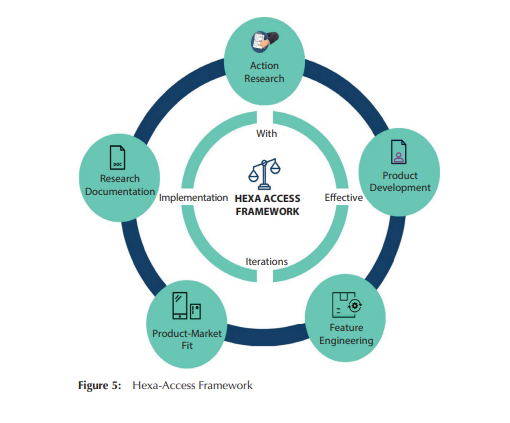
overcoming the obstacles to access to justice in the wake of dynamic technological advancement and innovation are listed below.
1. Action Research:
Mapping and incorporating within the platform the information around the typical range of problems citizens face in accessing timely justice which includes but is not limited to
◆
lack of idea about the legal provisions & scope to avail alternate dispute resolution options,
◆
difficulty in locating best-fit lawyers as per client needs & inability to afford legal services,
◆
asymmetry of information between lawyers and clients,
◆
challenge in getting dates of hearings in courts and adjournments.
A robust survey needs to be conducted at district levels to have an idea of the magnitude and variation of each of these problems based on demo- graphic variation. A dynamic FAQ section should be developed including in regional languages for users to
access important information around answers to the questions listed above at the click of a button on the envis- aged integrated platform.
2. Research Documentation:
Identifying broad trends about technology advances in various domains such as the private & public sectors and legal education through a thorough mapping with relevant stakeholders and doc- umenting case studies of successful adaption and impact along with learn- ings from failed initiatives and more specifically understanding why it failed the way it did in a particular context across geographies.
3. Product-Market Fit:
If the starting point of this reimagination of the jus- tice system beyond the sovereign service aspect it is usually perceived to be, is imagining access to justice as a service that ought to be provided seamlessly to all citizens for which the digital infrastructure is built, the envisaged platform must be a good fit to address the issues it is meant to solve. Understanding the implications of these technological changes for a variety of issues is crucial. These issues could be around access to technology, cost-effectiveness, transparency, and accountability. Just the sheer question of acceptability (and therefore uptake) is another question that must be answered. An example of what happens when this is not addressed properly is narrated earlier in this chapter.
4. Feature Engineering:
This refers to systematically engineering relevant fea- tures on the platform so the navigation time for the users to fetch the infor- mation they are looking for is minimised. This can enable users to address sector-specific access to justice questions such as those specific to commer- cial disputes, criminal cases and civil cases and learn as we go forward from the perspectives of different litigants ranging from citizens, and corpora- tions to the government. Queries should be categorised in the FAQ section using NLP (Natural Language Processing) methods and techniques such as
Lemmatization, Padding, and Word Embedding to dynamically club the questions under different case types.
5. Product Development:
For mainstreaming the use of this technology plat- form for citizen empowerment and enhanced access to justice, it should be able to answer the following questions in the affirmative: (a) Did the prod- uct cause the outcomes for the user to improve? Did it provide any solution for the dispute in question? and (b) Is the product design responsive and reflexive such that it can adapt and iterate based on user needs?
6. Implementation with Iterations:
For the five elements of the framework listed above to inform the product development and its enhanced usage, iterations to incorporate stakeholder feedback for sector-specific challenges is crucial. This sixth element can ensure a meaningful redesigning of the processes to effectively target efficiency gains in a continuum approach.
Effective Technology Implementation
The Hexa-Access Framework (HAF) can lead to effective gains in access to jus- tice only if it is combined with an effective technology implementation. While some elements of the HAF do include technology aspects, given its centrality, we believe it is
essential to further detail some key insights around technology implementation:
◆
Overwhelming Complexity:
The envisaged integrated technology platform is clearly complex and, unless care is taken, may often come at the cost of the user perspective. It is thus crucial that the front end be made user-friendly in a way that adoption by end users including different stakeholders such as court registry officials, police, prison officials, judges, lawyers and litigants can be expedited. Intuitive designing techniques need to be leveraged to build a platform that offers a seamless experience.
◆
Best Practices in Technology Architecture:
Develop a detailed technologi- cal architecture taking inputs from the best experts available. The architecture can learn from UIADI and other relevant digital public goods to facilitate technology mechanisms that allow further innovation and development connected to this platform for continuous improvement in access to justice. A key element of this is providing open APIs, a reusable and extensible modular architecture which are equipped with open and interoperable source codes with security features having essential guardrails in place. This would mean having the required controls in place that allow developers the flexibility to innovate within the boundaries of defined security policies.
◆
Design Feedback:
Open the architecture up for inputs from key stakehold- ers such as technology enthusiasts, developers, researchers, youth or broadly people who are technology savvy and willing to contribute towards building a more responsive judicial system with constant improvements keeping up
with the rapidly evolving technological advancements globally. This is a crucial step for taking feedback at the ideas stage itself, generating new ideas hitherto missed by the core development team and appropriate outreach and ownership development among
potential users.
◆
User Journey Simulations:
Once the platform is developed, before its for- mal launch, keep the draft version available for user journey simulations and conduct alpha users test, initially piloting with chosen users from all stake- holder categories such as judges, lawyers, court registry officials, citizens and researchers. This will collect feedback for appropriate iterations, before a formal launch for a beta test with a wider network of users. Finally, a robust mechanism to collect feedback for effective iterations to facilitate constant improvements and maximise adoption by end users should be a key feature of both the product as well as its outreach strategy.
We conclude this section and the chapter with some final remarks for the effective adoption of the proposed solution. While technological transformation is key to increasing access to justice and improving the efficiency in operations, a key to its success
is successful adoption by the end users and initiatives beyond techno- logical innovations need to be focussed on to ensure that. We describe two such initiatives taken in other countries to leverage the power of effective stakeholder awareness
and engagement.
The 90 Centros de Acceso a la Justicia (Access to Justice Centers) in Argentina offer extensive judicial and community services to local communities. Each centre has a staff of attorneys, psychiatrists, social workers, and community advocates who work
together to provide a comprehensive solution to justice-related issues by providing additional services and similar initiatives can be focussed on in the Indian context, especially in the rural hinterland which can significantly contrib- ute to
mitigating the overwhelming burden on the district courts. These centres can also potentially become centres not only for disseminating relevant legal knowledge to the potential litigant and diverting for ODR solutions but also become nudge units
for people to use the online portal of the courts for adopting user-friendly technology.
The National Action Committee on Access to Justice in Civil and Family Matters of Canada has stressed the significance of the justice system’s “front end,” which assists individuals in developing “a preventive set of knowledge, skills, and attitudes before
specific legal problems are encountered.” A system like this relies on a diverse network of intermediaries, such as women’s and community groups, schools and youth organisations, religious groups, hotlines, and libraries.
How the public sector should use its ability to bring people together to create an environment that encourages innovation, how the private sector, which has the ability to be flexible and creative in how it works, should look for ways to increase its
impact, how civil society can give views on people’s needs and wants, while aca- demia can provide the knowledge on how to connect these different strands (HiiL 2019). Thus, we recognise that leveraging the power of collaborative initiatives
allows for the pooling of resources; more importantly, it is the conscious advance- ment of a mindset that recognises that the multifaceted challenges of access to justice can only be addressed through large-scale cross-sectoral partnerships.
|
Editors’ Comments
This volume ends on this note: the future of the justice system is indeed bright when it can foster such cross-sectoral partnerships, taking all stakeholders along. The ecosystems approach of e-courts Phase 3, along with the proposed digital public goods
are key enablers of the same. While the plan and vision therein are aligned well, the question, as with all major projects always is: will the implementation do justice to the plan? The last section with its Hexa- Access Framework
and pointers on effective implementation attempts to provide some inputs, with hopes that the bright future will indeed be realised.
|
References
1. Justice for All. (2022).
Task Force on Justice, Justice for All – Final Report.
www.justice.sdg16.plus (Last accessed on 14 March 2022)
2. Cusatelli, C., & Giacalone, M. (2015). ICT Use by Judiciary Systems in European Union.
Journal of Applied Quantitative Methods
,
10
(2), 1842–4562.
3. Peter De Souza, S., & Spohr, M. (2021).
Technology, Innovation and Access to Justice
.
4. Bloomberg. (2020).
Artificial Intelligence Is Useful For Judicial Process But Can’t Replace Humans: Chief Justice Of India
http://www.bqprime.com/law-and-policy/ai-can-be-used-in-judicial-process-but-cannot-replace-human-discretion-cji
(Last accessed on 14 March 2022).
5. E-Committee SCI. (2021).
Digital Courts Vision & Roadmap Phase III of the eCourts Project
.
https://cdnbbsr.s3waas.gov.in/s388ef51f0bf911e452e8dbb1d807a81ab/uploads/2021/04/2021040344.pdf
(Last accessed on 09 July 2022)
6. Andrade, A., & Joia, L. A. (2012). Organizational structure and ICT strategies in the Brazilian Judiciary System.
Government Information Quarterly
,
29
(SUPPL. 1).
https://doi.org/10.1016/j.giq.2011.08.003
(Last accessed on 25 May 2022).
7.
OECD Good Practice Principles for People-Centred Justice.(2021).
http://www.oecd.org/about/publishing/corrigenda.xhtml
(Last accessed on 25 May 2022) .
8.
OECD Good Practice Principles for People-Centred Justice. (2021)
www.oecd.org/
about/publishing/corrigenda.htm(Last accessed on 25 May 2022).
9.
OECD Access to Justice - Organisation for Economic Co-operation and Development.(n.d.).
Retrieved 20 March 2023, from https://www.oecd.org/governance/globalroundtables-access-to-justice/ (Last accessed on 25 May 2022)
10. Pritchett, L., Woolcock, M., & Andrews, M. (2012).
Looking Like a State: Techniques of Persistent Failure in State Capability for Implementation
.
11.
OECD Access to Justice - Organisation for Economic Co-operation and Development.
(n.d.).
Retrieved 20 March 2023, from https://www.oecd.org/governance/global-roundtables-access-to-justice/ (Last accessed on 25 May 2022)
12.
Home — Courts of New Zealand. (n.d.).
Retrieved 7 July 2023, from https://www.
courtsofnz.govt.nz/ (Last accessed on 09 July 2022).
13.
Home page - Oikeus.fi
. (n.d.). Retrieved 7 July 2023, from
https://oikeus.fi/en
(Last accessed on 09 July 2022)
14.
European e-Justice Portal - National justice systems
. (n.d.). Retrieved 7 July 2023, from https://e-justice.europa.eu/16/EN/national_justice_systems?FINLAND&member=1 (Last accessed on 25 May 2022)
15.
Home | The Courts Service of Ireland.
(n.d.). Retrieved 7 July 2023, from https://www.
courts.ie/ (Last accessed on 09 July 2022)
16. NITI Aayog. (2021).
The ODR Policy Plan for India Designing the Future of Dispute Resolution
.
17. Salter, S. (2017). Online Dispute Resolution and Justice System Integration: British Columbia’s Civil Resolution Tribunal.
SSRN Electronic Journal
.
https://doi.
org/10.2139/SSRN.2965745 (Last accessed on 25 May 2022)
18. Sareen, D. (2018b). Online Dispute Resolution-Application and Challenges.
International Journal of Law Management & Humanities
,
1(5),
2581–5369. www.
ijlmh.com (Last accessed on 25 May 2022)
19. Sareen, D. (2018a). Online Dispute Resolution- Application and Challenges.
International Journal of Law Management & Humanities
,
1
(5), 2581–5369.
20. Sareen, D. (2018a). Online Dispute Resolution- Application and Challenges.
International Journal of Law Management & Humanities
,
1
(5), 2581–5369.
21. Salter, S. (2017). Online Dispute Resolution and Justice System Integration: British Columbia’s Civil Resolution Tribunal.
SSRN Electronic Journal.
https://doi.
org/10.2139/SSRN.2965745 (Last accessed on 25 May 2022)
22. High Court Allahabad. (n.d.).
Official Website of the High Court of Judicature at Allahabad and its Bench at Lucknow, U.P., India
India. Retrieved 21 March 2023, from
https://www.allahabadhighcourt.in/ (Last accessed on 09 July 2022)
23. E-Committee SCI. (2021).
Digital Courts Vision & Roadmap Phase III of the eCourts Project
.
https://cdnbbsr.s3waas.gov.in/s388ef51f0bf911e452e8dbb1d807a81ab/
uploads/2021/04/2021040344.pdf (Last accessed on 09 July 2022)
24. High Court Allahabad. (n.d.).
Official Website of the High Court of Judicature at Allahabad and its Bench at Lucknow, U.P., India
. Retrieved 21 March 2023, from
http://www.allahabadhighcourt.in/
(Last accessed on 09 July 2022)
25. E-Committee SCI. (2021).
Digital Courts Vision & Roadmap Phase III of the eCourts Project
.
https://cdnbbsr.s3waas.gov.in/s388ef51f0bf911e452e8dbb1d807a81ab/
uploads/2021/04/2021040344.pdf (Last accessed on 09 July 2022)
26. Seetharam, S., & Chandrashekaran, S. (2016).
eCourts in India from Policy Formulation to Implementation
.https://www.vidhilegalpolicy.in (Last accessed on 25 May 2022)
27. Seetharam, S., & Chandrashekaran, S. (2016).
eCourts in India from Policy Formulation to Implementation
. https://www.vidhilegalpolicy.in
(Last accessed on 25 May 2022)
28. Peter De Souza, S., & Spohr, M. (2020).
Technology, Innovation and Access to Justice: Dialogues on the Future of Law (Future Law series)
. Edinburgh University Press.
https://www.jstor.org/stable/10.3366/j.ctv1c29sj0 (
(Last accessed on 25 May 2022)
29. Peter De Souza, S., & Spohr, M. (2020).
Technology, Innovation and Access to Justice: Dialogues on the Future of Law (Future Law series)
. Edinburgh University Press.
https://www.jstor.org/stable/10.3366/j.ctv1c29sj0
(Last accessed on 25 May 2022)
30. E-Committee SCI. (2021).
Digital Courts Vision & Roadmap Phase III of the eCourts Project
.
https://cdnbbsr.s3waas.gov.in/s388ef51f0bf911e452e8dbb1d807a81ab/
uploads/2021/04/2021040344.pdf (Last accessed on 09 July 2022)
31. E-Committee SCI. (2021).
Digital Courts Vision & Roadmap Phase III of the eCourts Project
.
https://cdnbbsr.s3waas.gov.in/s388ef51f0bf911e452e8dbb1d807a81ab/
uploads/2021/04/2021040344.pdf (Last accessed on 09 July 2022)
32. E-Committee SCI. (2021).
Digital Courts Vision & Roadmap Phase III of the eCourts Project
.
https://cdnbbsr.s3waas.gov.in/s388ef51f0bf911e452e8dbb1d807a81ab/
uploads/2021/04/2021040344.pdf (Last accessed on 09 July 2022)
33. Justice for All. (2022).
Task Force on Justice, Justice for All – Final Report.
www.justice.
sdg16.plus (Last accessed on 14 March 2022)